|
The board affirms its commitment to the principles of openness, integrity and
accountability and is committed to providing timeous, relevant and meaningful
reporting to all stakeholders. It ensures that the company's business is
conducted in accordance with high standards of corporate governance and with
local and internationally accepted best corporate practice. These standards are
entrenched in the company's established systems of internal control by its
policies governing corporate conduct, with particular emphasis being placed on
the qualitative aspects of corporate governance.
The directors endorse the Code of Corporate Practices and Conduct (the Code)
set out in the second report of the King Committee on Corporate Governance (King
2) that was released in March 2002. The directors are of the view that the
company now substantially complies with the provisions thereof, and will, where
necessary, take appropriate steps to further enhance compliance in terms of the
recommendations.
All the key principles underlying the King recommendations as contained in
the Code are reflected in the company's corporate governance structures, which
are reviewed from time to time to take into account organisational changes and
international developments. Through this process of review the directors seek to
ensure that the company's business is managed on an ethical basis in accordance
with prudently determined risk parameters and in conformity with internationally
accepted standards.
The directors specifically report as follows:
Board Charter
On 6 August 2003, the board adopted a board charter, which regulates how
business is to be conducted by the board in accordance with the principles of
good corporate governance. The charter sets out the specific responsibilities of
the board members collectively, and the individual roles expected of them.
More specifically, the charter confirms the board's responsibility for the
adoption of strategic plans, monitoring of operational performance and
management, determination of policies and processes to ensure the integrity of
the company's risk management and internal controls, as well as director
selection, orientation and evaluation.
Risk management
The board is responsible for the total risk management process within the
company. Management is accountable to the board and has established various
systems of internal control to manage significant risks. These systems support
the board in discharging its responsibility for ensuring that the range of risks
associated with the company's operations are managed effectively and the
interests of stakeholders safeguarded.
During the year the company developed an integrated risk management framework
which identified the significant risks facing the company, as well as factors in
mitigation thereof, in order to further assist the board in the discharge of its
responsibilities.
While the operating risks cannot be fully eliminated, the company endeavours
to minimise it by ensuring that appropriate infrastructure, controls, systems
and ethics are applied throughout the company to manage such risks.
Responsibility for annual financial statements
The directors are responsible for the preparation of the annual financial
statements and related financial information that fairly present the financial
position of the company and the results of its operations and cash flows.
The annual financial statements set out in this report have been prepared in
accordance with International Financial Reporting Standards and South African
Statements of Generally Accepted Accounting Practice. These financial statements
incorporate full and responsible disclosure and are based on appropriate
accounting policies that have been consistently applied, except where otherwise
reported, and which are supported by reasonable and prudent estimates and
judgements.
The external auditors, whose report appears on page
30, are responsible for
reporting on these financial statements in conformity with statements of South
African Auditing Standards and in the manner required by the Companies Act in
South Africa.
Composition of the board of directors
The board comprises nine non-executive directors, details of whom appear on
page 28.
Two of the directors, Messrs M E Beckett and A S Malone are independent
non-executives.
Although there is currently no executive director, Mr. G T Lewis, the General
Manager, fulfils the role of Chief Executive Officer. He attends all board
meetings and reports directly to the board. In addition he attends all board
appointed committee meetings and reports directly to such committees.
All the directors bring to the board a wide range of professional and
commercial experience and independent perspectives and judgments.
Although Mr Sexwale, the chairman of the board, is not an independent
non-executive director, the board is of the view that it is appropriate that he
continues to chair the board, as he represents the company's major empowerment
shareholder.
The board is responsible to the shareholders for setting the direction of the
company through the establishment of strategic objectives and key policies. The
board meets quarterly, or more frequently if circumstances so require, in order
to consider issues of strategic direction, approve major capital expenditure
projects, review operating performance, and consider other matters having a
material effect on the company.
All directors are subject to retirement by rotation and re-election by
shareholders at least every three years in accordance with the company's
articles of association.
All directors have access to the advice and services of the company secretary
and, with the prior approval of the chairman, are entitled to seek independent
professional advice concerning the affairs of the company at its expense.
The board has established four standing committees, namely the Audit
Committee, the Health, Safety and Environmental Committee, the Nomination
Committee and the Remuneration and Employee Equity Committee, which operate
within defined terms of reference laid down in writing by the board. These
committees are chaired by and comprise non-executive directors.
Audit Committee
M E Beckett - Chairman
R H H van Kerckhoven
M J Willcox
The Audit Committee comprises three non-executive directors. The external and
internal auditors have free access to this committee. The committee is scheduled
to meet five times a year with management as well as with the internal and
external auditors to review the interim and preliminary reports, the annual
financial statements and accounting policies, the effectiveness of the internal
audit function, management information and other systems of internal control,
and to discuss the auditors' findings and recommendations.
The committee considers the use of the company's external auditors for
non-audit services, where appropriate, and also approves the fees to be paid to
the company's internal and external auditors.
In keeping with the recommendations of King 2, Mr M E Beckett, an independent
non-executive director was appointed Chairman in the place of Mr R H H van
Kerckhoven on 6 August 2003.
Internal audit function
The internal auditors provide an independent appraisal function with specific
responsibility to examine and evaluate the company's systems of internal control
in mitigation of identified business risks. The objective is to assist members
of management in the effective discharge of their responsibilities. The scope of
the internal audit function includes reviews of the reliability and integrity of
financial and operating information, the systems of internal control and the
means of safeguarding assets. The internal auditors report to the Audit
Committee and have unrestricted access to its chairman.
The internal audit function is undertaken on commercial terms by Anglo
Platinum Management Services (Proprietary) Limited.
Internal control
The directors are responsible for maintaining adequate accounting records and
have general responsibility for taking reasonable steps to safeguard the assets
of the company and installing systems to prevent fraud and other irregularities.
To enable the directors to meet these responsibilities, management has been
delegated with the responsibility of setting standards and implementing systems
of internal control aimed at providing reasonable assurance as to the
reliability of the annual financial statements, that assets are safeguarded and
that the risk of error, fraud or loss is reduced in a cost effective manner.
Nothing has come to the attention of the directors to indicate that any
material breakdown in the functioning of these controls has occurred during the
year under review.
Accordingly the financial records may be relied upon for preparing the
financial statements and maintaining accountability for assets and liabilities.
Health, Safety and Environmental Committee
B R van Rooyen - Chairman
M E Beckett
D T G Emmett (Alternate: Dr J R Johnston)
The Health, Safety and Environmental Committee comprises three non-executive
directors. The committee, which is scheduled to meet four times a year, is
tasked with overseeing the compliance by the company with the various health,
safety and environmental laws that affect the company, as well as advising the
board on issues relating thereto.
Although Mr. B R van Rooyen is not an independent non-executive director, the
board considers that the experience and knowledge that he brings to the
committee is such that it is appropriate that he chair the committee.
Nomination Committee
T M G Sexwale - Chairman
R Havenstein
A S Malone
E Molobi
In line with the recommendations of King 2, this committee was established on
6 August 2003, and comprises four non-executive directors. The committee, which
will meet at least once a year, is tasked with advising the board regarding the
size, composition and effectiveness of the board and board appointed committees,
as well as advising the board regarding the appointment of proposed candidates
to serve on the board.
Remuneration and Employee Equity Committee
A S Malone - Chairman
R Havenstein
E Molobi
T M G Sexwale
The Remuneration and Employee Equity Committee comprises four non-executive
directors and is scheduled to meet four times a year. The committee in
consultation, where necessary, with management, ensures that the company's
employees are fairly rewarded for their contribution to the company's
performance. The company's remuneration philosophy is to ensure salaries and
related benefits are competitive relative to other mining companies.
Specifically, the committee, on behalf of the board, approves the employment
contracts and remuneration packages of senior management, ratifies the
appointment of senior management other than directors, and approves any
short-term incentive schemes and bonuses, including the offer of options in
terms of the rules of the Northam Share Option Scheme. In addition, the
committee approves the mandate in regard to negotiations with trade unions and
oversees implementation of and compliance with the requirements of the
Employment Equity Act and the administration of the company's share incentive
scheme.
In keeping with the recommendations of King 2, Mr A S Malone, an independent
non-executive director, was appointed chairman in the place of Mr T M G Sexwale
on 6 August 2003.
Communication
The company has a policy of communicating openly and regularly with its
shareowners, employees and other stakeholders. Communications with shareowners
exceed the statutory requirements and include press releases, briefings and a
website. Communications with employees and other stakeholders are in the form of
an in-house news publication and regular briefings.
Code of ethics*
The company is committed to the highest ethical standards in its dealings
with all its stakeholders, and to this end has adopted a code of ethics which
governs the relationship between the company and its employees, the company and
the environment, the company and its suppliers and customers, as well as the
company and the community.
In promoting the code, the company is committed to:
- Defending the right of employees to a safe and healthy working
environment;
- Conducting its business in such a way that promotes the recognition of the
environment as a strategic asset for both current and future generations;
- Applying the highest ethical standards in its dealings with customers and
suppliers;
- Supporting communities to improve the quality of their lives;
- Creating a climate free of conflict, discrimination and harassment;
- Engaging constructively and creatively with government bodies, labour
organisations and non-governmental organisations (NGOs);
- Providing a channel through which grievances or breaches of the code can
be dealt with without fear of victimisation.
*The unabridged code of ethics appears on the company's website www.northam.co.za
Closed periods
The company maintains a closed period of six weeks prior to the publication
of its interim and final results. During this time and other periods as
determined, directors and employees are precluded from dealing in the company's
shares. Outside of any closed periods, directors and employees are required to
obtain approval prior to dealing in the company's shares.
Attendance at board and committee meetings
The attendance by the directors at board meetings and the various committee
meetings during the year under review is reflected in the following table:
|
|
|
|
Health, Safety |
Remuneration and |
|
|
Audit |
and Environmental |
Employment |
|
Board |
Committee |
Committee |
Equity Committee |
|
meetings |
meetings |
meetings |
meetings |
|
| Number of meetings held |
5 |
5 |
4 |
3 |
|
| Attendance per director |
| M E Beckett |
4 |
4 |
3 |
n/a |
| B E Davison (1) |
2 |
n/a |
n/a |
2 |
| D T G Emmett |
5 |
n/a |
4 |
n/a |
| R Havenstein (2) |
n/a |
n/a |
n/a |
n/a |
| A S Malone |
4 |
n/a |
n/a |
2 |
| E Molobi |
4 |
n/a |
n/a |
2 |
| T M G Sexwale |
5 |
n/a |
n/a |
3 |
| R H H van Kerckhoven |
5 |
4 |
n/a |
n/a |
| B R van Rooyen |
5 |
n/a |
4 |
n/a |
| I C Watson (3) |
2 |
3 |
2 |
1 |
| M J Willcox |
4 |
2 |
n/a |
n/a |
| J R Johnston (4) |
n/a |
n/a |
1 |
n/a |
|
(1) Mr B E Davison resigned as a director with effect from 30 June
2003.
(2) Mr R Havenstein was appointed a director on 1 July 2003.
(3) Mr I C Watson retired as a director on 16 December 2002.
(4) Alternate member to Mr D T G Emmett on the Health, Safety and
Environmental Committee.
 |
 |
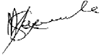
| T M G Sexwale |
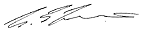
M E Beckett |
| Chairman |
Chairman - Audit Committee |
| Johannesburg |
12 September 2003
|
|