![Northam [logo]](https://www.northam.co.za/assets/investors/reports/2015/img/cover-logo.svg)
Managing material risks and opportunities
The board is responsible for establishing and maintaining an effective system of internal control to guard against any loss of group assets. Internal and external auditors, as well as management, continuously provide assurance on the effectiveness of internal controls.
The risk assessment and management function covers any material routine transactional or occasional risks that a mining group of the nature and size of Northam, is subjected to in the ordinary course of business. Risk assessment is an executive management function and is overseen by the audit and risk committee on behalf of the board.
In terms of the group’s risk management framework, which incorporates an ongoing risk review process, the major risks of the group that may materially affect its ability to create value from business opportunities are identified, and ranked on the basis of their materiality. Inherent risk and mitigating steps are identified, so as to ensure that the level of residual risk is acceptable to management. Assessing risk includes testing the extent of compliance with applicable legislation, and is performed by completing the regulatory compliance scorecard.
The board of directors appreciates that sustainability is an ethical and economic imperative for business in the 21st century – both in terms of risk management and the opportunities it presents. The relationship between good governance, good leadership and excellent financial performance is evident, and entails defining strategy, providing direction and establishing the ethics and values that will influence and guide practices and conduct with regard to sustainability performance.
| RISKS IDENTIFIED (as at April 2015) | MANAGEMENT RESPONSE |
|---|---|
| National regulatory risk | |
|
|
|
|
| Geological and ore resource risk | |
| Mining the Merensky Reef at Zondereinde is complex and challenging, which impacts on its availability. | Merensky reef remains difficult to mine in the short term. Management is pursuing the deepening project at Zondereinde mine in order to open more face for Merensky ore. A higher proportion of UG2 ore is to be mined as it is more readily available, with the UG2 to Merensky proportion changing from 1:1 to 65:35. Management intends to construct a new 20MW furnace which is designed to take increased volumes of UG2 production. Booysendal mine provides geographic diversification and access to a less complex, shallower ore body that can be mined mechanically. |
| Labour and socio-political risk | |
| Several events and factors have resulted in a volatile and uncertain climate in the South African mining industry, especially in the Rustenburg platinum belt. These include the tragic events at Marikana in 2012; inter-union rivalry and militancy, especially between the NUM and AMCU; and strike action called by AMCU which saw a five-month strike in 2014 – the longest strike in our country’s labour relations history – affecting Anglo American Platinum, Impala Platinum and Lonmin. | In recognition of employees’ freedom of association, Northam’s policy is to grant organisational rights to any union with representation of 15% or more of a relevant category of employees. Management maintains open channels of communication with its labour force, both directly with, for example, employees of influence and with representative union structures. For bargaining rights, a union is required to prove 33.3% representation of its relevant constituency. In addition, management consults with any legitimate worker representatives or committees to resolve any concerns which may arise. At Zondereinde, interdicts through the Labour Court were used when necessary, such as during the one week unprotected strike in January 2015. Stakeholder liaison with the local SAPS is in place in the event of possible industrial action. Our negotiations with unions for F2016 began at the end of F2015. Post financial year end, a wage settlement was reached which was a good outcome for both employees and the company. At Booysendal, mining and plant contractors signed two-year agreements in July 2013 and no major labour difficulties are expected on the eastern limb. We also engage proactively over socio-economic issues with employee communities, and have initiated our Accommodation Strategy 2020 to improve employee housing and related infrastructure. Please go to material issue 4 for the latest on this Strategy. Employee empowerment, including the expansion of a bigger and better Toro Trust, is also part of our approach. Northam fully participates in any meetings or forums set up by the DMR, local municipalities and other mining companies in the areas where its mines are located. Soon after year-end there were disturbances in the communities around Booysendal mine. Northam fully participated in the ministerial efforts to calm the area. The current leadership model is being reviewed to determine what aspects can be adjusted to accommodate the changing labour climate, with an emphasis on succession and communication. |
| Skills shortage risk | |
| Global competition for expertise and skills in the technical field as well as the distance of the operations from major urban centres, have put pressure on the group to attract and retain appropriate technical skills. | The group has developed appropriate remuneration policies and practices to retain its technical skills competitive edge in the industry and aims to keep abreast of developments in this area. There is a management drive to attract affirmative action (AA) senior level appointments in the next one to two years. Inhouse training and mentoring have been improved to promote skills enhancement, with external recruitment being applied where necessary. Our executive: human resources is focusing on succession planning, in collaboration with heads of departments who identify qualified and appropriate candidates. More recently this risk is transforming into an opportunity for Northam as more skilled and trained employees come on to the market, given the turbulent times in the resource sector. |
| Fraud and corruption risk | |
| Fraud is South Africa’s number one economic crime and is an activity particularly prevalent during an economic downturn. The company strongly condemns bribery, fraud and corruption in accordance with its code of ethics. | Internal and external audits and control reviews are continuously conducted. We recently increased awareness of our whistleblowing and ethics hotline via pamphlets at both operations. We have a security sub-department which reports to finance. |
| Market and financial risk | |
|
|
|
|
| Operational risk | |
|
|
|
|
| Health and safety risk | |
| The occupational illnesses associated with underground mining operations are those caused inter alia, by excessive exposure to heat, dust, noise, radiation and gases. Consequently, the mining industry is subject to stringent health and safety laws and regulations. In certain cases, amendments to health and safety legislation could result in the group incurring additional costs in order to comply with new laws and regulations. In addition, the industry as a whole is experiencing the negative effects of medical pandemics such as HIV/Aids and TB. These medical conditions adversely affect productivity and costs. | Underground mining is inherently hazardous and requires full compliance with health and safety regulations, compulsory safety training and the use of personal protective equipment. Non-compliance with safety standards may lead to costly mine stoppages. Our established health and safety department has implemented health and safety codes of practice and standard operating procedures are in place. The Chamber of Mines’ safety system is to be implemented. A Standard Process and Advisory Group has been established whereby policies and procedures are reviewed on an ad hoc basis. Management performs ad hoc underground visits to verify adherence to safety standards. The group’s proposed growth strategy which involves acquiring and/or developing shallow mechanised mines or reserves and thus growing “down the cost curve” is also a mitigant against the safety risk as the mechanised mining method is far safer and employs far fewer workers underground. The group has adopted a zero tolerance policy towards safety infringements. All infringements are investigated, and employees may face disciplinary hearings, which may lead to suspension or dismissal. In addition, the group undertakes continuous training campaigns for its employees. Mining safety standards are meticulously and constantly revised in order to facilitate compliance. Where possible mechanisation is favoured and implemented as a mining method given its improved safety record. At Zondereinde, the use of hydropower itself largely eliminates the presence of dust in the workings. HIV/Aids and TB have been aggressively targeted with a strong focus on prevention, through education initiatives and community involvement, as well as the implementation of a monitored employee wellness programme which includes the provision of anti-retroviral treatment (ART) for those affected. |
| Infrastructural service supply risk | |
| The group is dependent on the reliable supply of power in order to conduct its operations. South Africa’s national electricity utility, Eskom, currently has very little surplus generating capacity and is struggling to provide a reliable service to the industry. Eskom has sought to limit power consumption by large users such as mines during peak hours, by up to 10%. | The group has engaged with Eskom so that it is given advance warning of any possible outages in order to secure employees’ safety and protect its assets. It is not always possible to determine the cost of power disruptions, which are likely to persist in the medium term. The group has instituted a number of measures in order to reduce its maximum demand as well as to lower its total power consumption. These include dieselpowered machinery, an electricity management programme to assist Eskom and automated emergency generators to allow co-generation. Booysendal mine, being a mechanised mine, is relatively less reliant on Eskom power. In addition, the mine has been designed in such a way that it can continue operating for several hours with reduced electricity supply. |
| Growth strategy execution risk | |
| Too aggressive an expansion increases risk. Funds, skills and patience are all necessary ingredients for successful growth. Added pressure has been placed on the company by the tough targets set for the success of the BEE transaction. The management and operating of new mines requires good assets, good people, efficiency and finding synergies. | Management intends to grow the group through both internal and external opportunities identified on a continual basis. These opportunities need to be value accretive for Northam’s shareholders not least in order to meet and exceed the Zambezi Platinum preference dividends yield threshold of prime interest rate + 350 basis points compounded over 10 years. Management has built the corporate office team in line with the human resource and project execution needs of an expanding company. |
RISK FINANCING
Risk financing is an integral part of the group’s risk management philosophy. In this regard, the group ensures that it has adequate insurance cover to safeguard it against major losses which could affect future earnings. Insurance cover is arranged in respect of material damage and business interruption, and is split between the South African and international insurance markets.
HEALTH AND SAFETY
The board-appointed health, safety and environmental committee is ultimately responsible for ensuring compliance with legislation and monitoring performance with regard to health and safety. The committee, comprising three non-executive directors, meets on a quarterly basis.
SAFETY CO-ORDINATION
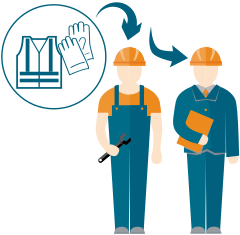
Overall co-ordination of the safety function vests with the best practice manager who reports directly to the general manager.

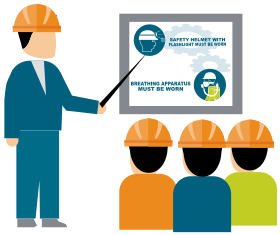
The best practice department is tasked with the overall training and optimisation function.

Risk management is an integral part of this structure, and risk management processes are used to drive the revision of standards and updating of training material.

Safety officers audit the requirements as defined by the standard procedures and the training of employees as specified by the training material.
| Zondereinde mine | Booysendal mine |
|---|---|
| Type of operation | |
|
|
| Safety personnel | |
|
|
| Safety record | |
|
|
INTEGRATED REPORTING AND DISCLOSURE
Policies, practices and performance relating to sustainable development form an integral part of the management of the group. Responsibility for these matters lies with the board. The audit and risk committee assists the board in approving the disclosure of sustainability issues in the annual integrated report. This document provides extensive discussion on the operational and financial performance of the group and the material environmental, social and governance (ESG) issues that underpin the group’s business performance. This comprehensive disclosure enables stakeholders to make an informed assessment of the economic viability of the group and the sustainability of its business.
COMBINED ASSURANCE
The audit and risk committee assisted by management ensures that a combined assurance model is applied to provide a co- ordinated approach to all assurance activities. The committee makes sure that the assurance received addresses all significant risks facing the company, and also monitors the relationship between the external assurance providers of the company.