![Northam [logo]](https://www.northam.co.za/assets/investors/reports/2015/img/cover-logo.svg)
Corporate profile
Northam is an independent, fully empowered, mid-tier, integrated PGM producer with two primary operating assets, the Zondereinde and Booysendal platinum group metal (PGM) mines in the South African Bushveld Complex. Northam has its own metallurgical operations, including a base metals removal plant and smelter, on the Zondereinde lease area. Performance reported in this report only relates to these mines where the company is the operator.
- The Zondereinde mine is a mature operation and produces approximately 280 000oz of PGM in concentrate annually. The mine is located on the northern end of the western limb of the Bushveld Complex near the town of Thabazimbi. Zondereinde has a life-of-mine of 21 years.
- The shallower mechanised Booysendal UG2 North mine is located near the town of Mashishing on the eastern limb of the Bushveld Complex. The mine came into production on 1 July 2013. At full production, the mine should produce approximately 160 000oz annually.
In February 2015, Northam acquired the Everest platinum mine (now known as Booysendal South) from Aquarius Platinum (South Africa) Proprietary Limited (AQPSA), contiguous to the Booysendal orebody. The integration process with the existing greater Booysendal operation has begun, which will allow the company to begin extracting value and developing the new Booysendal South mine.
Northam Chrome Producers Proprietary Limited (NCP) is a wholly-owned subsidiary of Northam. NCP produces chrome from Zondereinde mine’s UG2 tailings.
The company holds a 7.5% interest in another PGM mining operation in the Bushveld Complex, the Pandora joint venture (JV), in partnership with Anglo American Platinum Limited and Lonmin plc.
Northam also owns a 50% interest in the Dwaalkop PGM JV, a 51% initial participatory interest in the Kokerboom JV exploration project in the northern Cape and a 20.3% interest in listed diamond miner, Trans Hex Group Limited (Trans Hex).
The company milled a total of 3.6Mt (Zondereinde: 1.8Mt, Booysendal: 1.8Mt) in the year under review to produce 11 759kg of metal in concentrate, which has been processed to realise sales revenue of R6.0 billion (F2014: R5.3 billion) – an increase of 13%, largely due to the ramp up of production at Booysendal.
At 30 June 2015, Northam held a combined resource base of 194.4 million ounces (Moz) – 19.2Moz in the reserve category – with a mining life of more than 50 years.
and free float (%)
SHAREHOLDER BASE
Northam’s shares are listed on the JSE. Its share code is NHM and its debt instruments are listed under the symbol NHMI. The company has been admitted to participate in the JSE’s Socially Responsible Investment (SRI) Index.
BEE SHAREHOLDING IN NORTHAM
Northam is a fully empowered PGM producer. Historically disadvantaged South African (HDSA) ownership levels in the company are pegged at 35.4% following the conclusion of a R6.6 billion black economic empowerment (BEE) transaction, which included the successful raising of R4.6 billion. The transaction was concluded in October 2014 and approved by shareholders in March 2015. In terms of the deal, Northam issued 112 195 122 new shares (equivalent to 22% of Northam’s issued share capital) to a special purpose BEE vehicle known as Zambezi Platinum (RF) Limited (Zambezi or Zambezi Platinum). These shares were supplemented by 47 710 331 shares (equivalent to 9.4% of Northam’s issued share capital), sold to Zambezi Platinum by the Public Investment Corporation SOC Limited (PIC), a long-standing Northam shareholder.
Zambezi Platinum comprises a range of HDSA stakeholders including an employee trust, two community trusts, a women’s group and a core of strategic partners. Together they hold a 31.4% stake in Northam. This holding, added to a 4% BEE credit recognised through the Toro Trust (a profit share scheme) takes the company’s HDSA equity to 35.4%, in excess of the Mining Charter requirements, and with a 10-year lock-in period for the participants.
Zambezi Platinum is financing the acquisition of shares in Northam through a preference share arrangement. Apart from this function Zambezi Platinum will not conduct any operational business. Zambezi Platinum’s preference shares were listed on the JSE on 11 May 2015.
By the end of the 2015 financial year Northam’s share capital had increased to 509 781 212 shares in terms of the BEE transaction (2014: 397 586 090 shares). At the end of the 2015 financial year, the company’s market capitalisation was R20.5 billion.
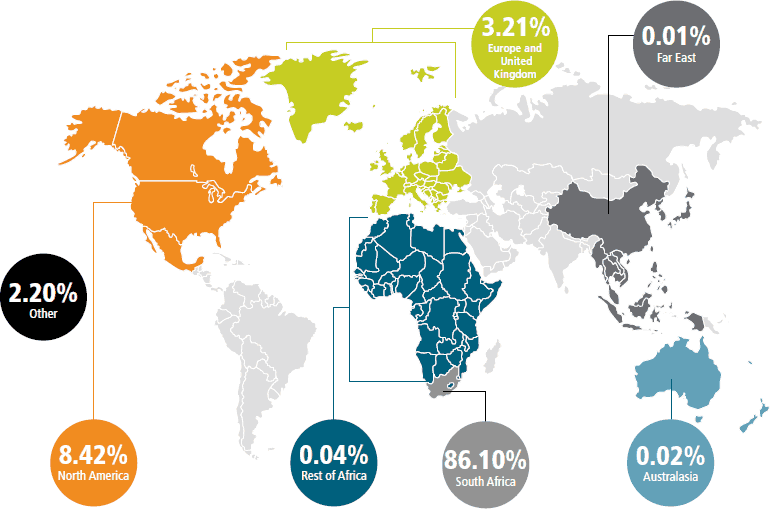
Northam has a geographically diverse shareholder base, which at 30 June 2015 comprised predominantly institutional investors in South Africa (86.10%), North America (8.42%), Europe and the United Kingdom (3.21%), the Far East (0.01%), Australasia (0.02%) and the rest of Africa (0.04%).
PRODUCTS AND END USES
Northam’s primary products are the three main PGMs: platinum, palladium and rhodium. The primary consumers of the three main PGMs are the motor-manufacturing and jewellery industries. Other industrial uses range from chemical and electrical applications to glass manufacture. In the automotive sector, PGMs are used in exhaust systems, specifically autocatalysts, helping to reduce noxious gases released into the atmosphere. Platinum jewellery is popular in Asia.
PGMs have also attracted investment attention with the launch of exchange-traded funds (ETFs), which expose investors to physical metal holdings.
PGMs are traded on international markets where the metal prices are determined by global supply and demand, and are US dollar-denominated. This means that South African PGMs realise prices in US dollars, which are then converted and reported in South African rands on the income statement. Northam has little or no influence on the pricing of the sales of its metal and is essentially a price taker. The metal is sold in sponge or ingot form to customers in the US, Europe and the Far East.
Northam’s in-house marketing department is responsible for marketing and sales of products domestically and to major global markets in Asia, Europe and North America.
OPERATING APPROACH
In terms of market capitalisation, Northam ranks as a mid-tier PGM producer. The company is distinguished from its peers and other smaller PGM producers in that its activities are integrated; from the underground mining function, through to the concentrating, smelting and base metal removal processes.
Final precious metal concentrate is transported from Zondereinde platinum mine and metallurgical complex for refining to the Heraeus facilities in Germany and Port Elizabeth. By-product metals, copper and nickel sulphate, are extracted at the on-site base metals removal plant and sold in the domestic market.
For about 20 years, Zondereinde was Northam’s only operating asset. Construction of the shallow mechanised Booysendal mine started in 2010 and, for Northam, represents a significant diversification in terms of geography, mining method, safety, costs and, consequently, lowers the risk that the company is otherwise exposed to with a single operating asset. Booysendal came into production in July 2013 and it achieved over 80% of its steady state production by 30 June 2015. Its ramp-up to reach steady-state production in F2016 continues.
ZONDEREINDE
Zondereinde is a deep-level conventional mining operation producing approximately 280 000oz of PGM per annum. The mine incorporates a metallurgical complex, comprising a smelter and a base-metal removal plant.
Zondereinde is a deep level platinum mine. Its complex geology is characterised by potholed reef and fault structures. Ore grades are relatively high at Zondereinde, as are the metallurgical recoveries from both the Merensky and UG2 ore. The mine’s resource is estimated at 81.1Moz.
To extend the life of mine and to access more conformable Merensky reef, a deepening project to 2 300 metres below surface is underway. The development of infrastructure which includes a conveyor decline, a chairlift and a material decline from 13 level to 18 level, is at an advanced stage, with the commissioning of an underground refrigeration plant having made a marked improvement to environmental conditions at depth. Originally planned as a Merensky mine, the focus is shifting to mining a higher proportion of UG2 ore. Along with the deepening project this shift in reef profile has extended the life of mine to 21 years.
BOOYSENDAL
At steady state levels, anticipated in the first half of the 2016 financial year, the Booysendal North mine will be producing 2 250 000 tonnes of ore per annum, generating around 160 000oz of metals in concentrate (3PGE+Au), together with associated precious and base metal by-products.
The Booysendal North mine is a shallow, fully mechanised UG2 mining operation, with a resource of 6.4Moz. Current life of mine is upwards of 20 years. The total Booysendal resource is in excess of 100Moz and with the development of additional mining modules could support mining operations for more than 50 years.
The Booysendal North mine has been developed as a room and pillar operation. The main underground infrastructure consists of the following key elements:
- A reverse decline system consisting of two barrels. The main barrel contains the conveyor belt and chairlift for the transfer of rock and personnel. The other barrel is for the movement of mechanised equipment into and out of the mine.
- Unique to the Booysendal design is the footwall decline placed some 24m below the reef horizon. It is typical in most room and pillar operations to have a conveyor placed on reef. At Booysendal some buffer storage capacity was designed and constructed in order to mitigate any risk related to interruptions in power supply, particularly at peak times. The buffer storage will allow continuous operations for up to 12 hours on the reef horizon should the footwall conveyor be offline; the placement of the conveyor in the footwall allows for rock hoisting to surface during off peak periods.
- There are three main on-reef declines, a central decline for the movement of mechanised equipment and two additional declines; one north and one south of the central decline, to provide access to the tips of the main ore pass system.
PROCESSING
Merensky and UG2 concentrator plants
- Crushing/screening circuit: In the crushing/screening circuit the ore is crushed to reduce its size before it reports
into the mill. - Milling: Merensky ore feeds into a fully autogenous (FAG) mill. In the UG2 plant, the crushed product feeds into a high pressure grinding roll and then into a primary ball mill.
- Flotation: The circuit includes rougher cells, scavenger cells and cleaner columns. External sparger column cells act as a cleaner and this helps to produce a final UG2 concentrate with significantly lower chrome content while maintaining PGM recoveries.
Smelting operations
Commissioned in 1993, the existing smelter has a 15MW capacity. Key processes include drying, smelting and converting the concentrate. Concentrate brought in is blended and dried concentrate is pulverised and then stored in silos. Off-gases are cleaned in an electrostatic precipitator. Concentrate and flue dust is mixed with lime and then fed through to the day bin and into the furnace where electrodes provide heat. The lighter oxides float to the top as slag and the more dense sulphides, which contain the PGMs, sink to the hearth as furnace matte.
New furnace
The board has approved capital expenditure for the installation of a new 20MW furnace as part of the smelter expansion and de-risking programme. Initially, a sum of R10.0 million has been committed for design and drawing work for the new furnace. The project estimated at R750.0 million is expected to be completed over the next three years. The additional capacity will add significant mining flexibility allowing for higher volumes of UG2 to be mined and treated.
REFINING
Since 1992, Northam’s production of metal has been refined in Germany, with PGM concentrate being delivered on a weekly basis to the Heraeus refinery in Hanau near Frankfurt. Latterly some of Northam’s material has also been treated at the Heraeus plant in Port Elizabeth, South Africa.
A registered member of the London Platinum and Palladium Market (LPPM), Heraeus has London-Zurich ‘Good Delivery’ status for metal production. The refinery in Hanau is subject to strict European Union and materials handling protocols. Product transportation is also strictly defined by international aviation regulations.