![Go to home page [Northam logo]](images/logo.png)




EMPLOYMENT AND HUMAN RIGHTS
Key performance indicators – F2011
- six-week strike
- 6.93% women in mining
- 45% HDSAs in management
- labour turnover drops to 6.6%
Management approach
The management of the people of Northam is the responsibility of the general managers of the Zondereinde mine and the Booysendal project and, ultimately, the chief executive of the company.
The remuneration, nomination and employment equity committee of the board is ultimately responsible for overall oversight. This committee, in consultation where necessary with management, ensures that the group’s employees are equitably and appropriately rewarded for their contribution to the group’s performance.
The group’s remuneration philosophy is to ensure that salaries and related benefits are competitive relative to other mining companies. Specifically, the committee, on behalf of the board, approves the employment contracts and remuneration packages of senior management, ratifies the appointment of senior management other than directors, and approves any short-term incentive schemes and bonuses, including the offer of options in terms of the rules of the Northam Share Option Scheme.
The committee approves the mandate with regard to negotiations with trade unions and oversees implementation of and compliance with the requirements of the Employment Equity Act and the administration of the group’s share incentive scheme.
The information presented below relates to the Zondereinde mine, which has a stable workforce and established systems and processes in place. While the management of people is a line management function, extensive support is provided by the Zondereinde minebased human resources department. This department is also responsible for driving the implementation and achievement of human resources strategy including all aspects of the Mining Charter.
Other areas of focus are:
- training and development at all levels, with specific emphasis on leadership development and mentorship;
- recruitment and retention and employees;
- facilitation, co-ordination of implementation of employment equity programmes;
- labour relations, including collective bargaining;
- organisational development with respect to performance and talent management; and
- stakeholder and compliance management.
Labour and management relations
Northam strives to be a fair employer, providing constructive and relevant work in an environment that allows employees the opportunity to develop their skills and grow as individuals.
The following key employment legislation and agreements govern the basis upon which all interactions and engagements with employees and organised labour are conducted:
- Employment Equity Act.
- National Skills Development and Skills Development Levies Act.
- Basic Conditions of Employment Act.
- Labour Relations Act.
- Mineral and Petroleum Resources Development Act.
- Recognition agreements with organised labour.
Collective bargaining structures, which govern remuneration and conditions of service for most employees (84%), are negotiated annually.
Performance reviews are undertaken on an annual basis for employees who do not form part of these bargaining units. In addition, all employees’ skills development plans are reviewed on a recurring basis. (See discussion on skills audit below). The current performance management system is being reviewed and improved upon to ensure that all aspects of performance, including legal compliance priorities are measured effectively and accurately. Skills development plans for individuals are based on both the company skills requirements as well as development objectives for targeted individuals. Emphasis is placed on historically disadvantaged South African (HDSA) employees in order to assist the company with maintaining a pool of relevant and effective skills amongst HDSA employees.
As Booysendal is currently in development phase, work at Booysendal is primarily done through contracting companies. There are no agreements in place with organised labour.
Employment practices
Northam is committed to fair and progressive employment practices, providing long-term employment opportunities with the scope for employees to develop their potential. Competitive remuneration practices take into account the nature of the operation, the innovative mining practices as well as the remote location of its operations.
Benefits provided to full-time employees include:
- membership of pension and provident funds;
- death benefits;
- access to medical care;
- housing and living-out allowances;
- study assistance; and
- maternity and paternity leave.
The Toro Employee Empowerment Trust, which was established in August 2008, represents the interests of some 98.7% of the company’s Zondereinde employees. During F2011 the company contributed R13.6 million (F2010: R23.1 million). In F2011, the net income of the trust was R3.4 million (F2010: R0.3 million). The net interest of the beneficiaries at 30 June 2011 was R85.5 million (F2010: R70.9 million), with the first payouts to employees planned for 2013.
Human rights and collective bargaining
Northam upholds the basic labour rights enshrined in the Fundamental Rights Convention of the International Labour Organization (ILO) relating to collective bargaining and ensures the implementation of fair employment practices. The company prohibits forced, compulsory and underage labour, and any form of discrimination based on inter alia race, religion, age, disability or political affiliation.
The rights to freedom of association and collective bargaining are entrenched within South Africa’s legislation and the country’s constitution. Northam supports employees’ rights and acts in accordance with the South African constitution, prescribed legislation, industry compacts and recognition agreements with unions. A sexual harassment policy is in place which prohibits harassment, an issue of particular concern in the recruitment and retention of female employees (see section on women in mining below).
Collective bargaining structures, policies and practices are embedded at all levels of operation and ensure employment practices are fair and employees are represented appropriately. Minimum notice periods in respect of operational changes and rates of pay for men and women are prescribed by legislation.
Legislative compliance, enhanced by collective bargaining structures, policies and practices are embedded at all levels of operation and ensure employment practices are fair and employees are represented appropriately.
Wages and other conditions of service are negotiated on an annual basis. Recognition agreements with unions also regulate aspects such as participation in safety and health structures and disciplinary and grievance procedures.
In terms of the recognition agreements between Northam and organised labour, each union requires a representivity threshold of 33.3% within the bargaining unit in order to bargain for that particular unit.
Northam ensures that there is no risk to the right to exercise freedom of association and collective bargaining by employees, contractors and suppliers through compliance by the company, its contractors and suppliers with South African legislation and the company’s own policies.
| Union | Cat 2-8 | Cat 9 | Cat 10 | Total | ||||
|---|---|---|---|---|---|---|---|---|
| Complement | 5 945 | 399 | 394 | 6 738 | ||||
| NUM | 5 020 | 84.45 | 105 | 26.38 | 100 | 25.25 | 5 225 | 77.55 |
| Solidarity | 39 | 0.66 | 173 | 43.47 | 165 | 41.67 | 377 | 5.60 |
| UASA | 3 | 0.05 | 11 | 2.76 | 23 | 5.81 | 37 | 0.55 |
| Total | 5 062 | 85.16 | 289 | 72.61 | 288 | 72.73 | 5 639 | 83.69 |
* This table only represents employees in collective bargaining units
Establishing and maintaining constructive relations with unions
Annual wage negotiations to establish wage levels for F2012 started during the last quarter of the financial year and have yet to be concluded.
In total, 37 days were lost during in F2011 as a result of industrial action following a dispute related to wages. The six-week strike resulted in revenue losses of approximately R380 million for the company and has impacted on every aspect of the day-to-day operation of the mine. Employees lost R65.1 million in wages overall.
The company has launched a concerted effort to improve labour/management communication. This includes the drafting of a partnership charter with unions, training and capacity building for the newly established employment equity and training committee which comprises representatives of individuals from all occupational levels, organised labour and management. These interventions will assist to govern and support all employees involved in consultations and engagements with all relevant structures at Zondereinde.
Performance F2011
Employment
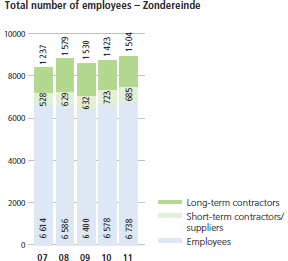
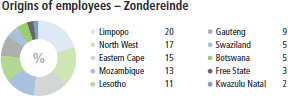
At the end of June F2011, Northam employed 10 096 people, 6 851 full-time, permanent employees, 1 504 long-term, permanent contractors and 687 short-term, part-time contractors at Zondereinde and 1 054 people, mostly construction contractors at Booysendal. It is expected that the permanent employment at Booysendal will increase to 1 200 once the mine reaches steady-state production in 2014.
At the end of June 2011, 19% of permanent employees at Zondereinde were drawn from the Limpopo province (F2010: 18%), while a further 47% (F2010: 45%) were from other provinces in South Africa, and 34% (F2010: 37%) from neighbouring countries. While the company does not discriminate against foreign labour, Northam remains committed to increase the local labour representation at both Zondereinde and Booysendal to facilitate the allocation of wealth and skills to those most affected by its operations.
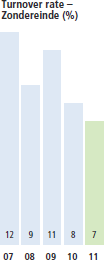
As at 30 June F2011, the total turnover level at Zondereinde was 6.6% (F2010: 8.0%), with a total of 487 (F2010: 539) people leaving the employ of the company during period. These 457 departures may be ascribed to resignation (221), misconduct (143), incapacity (66.0%) and death in service (50).
Local employment at Booysendal
Located in a region of little economic activity, a particular issue of concern at Booysendal is the allocation of jobs. As a new business in the area, the company endeavours to engage with local community structures, including the Greater Tubatse local and Greater Sekhukhune district municipalities on an ongoing basis.
As part of Northam’s commitment to the Mining Charter and the Booysendal social and labour plan, the company is fully committed to developing skills and promoting economic activity amongst the communities in which their operations are located. Although there are limited vacancies currently at Booysendal mine, going forward, the mine will require employees with the necessary skills and experience particularly in the fields of engineering, trackless mining and plant operation.
In order to establish the level of required skills in the nearby communities and to identify individuals who possess these skills, Booysendal has developed a dynamic skills database. This skills database was compiled by way of hosting several open days to give community members from the surrounding Greater Tubatse and Taba chweu local municipal areas the opportunity to fill in an individual profile summary and submit their details for inclusion in the database. The skills database is, and will continue to be used by contractors and the mine as a reference to source employees from the local communities.
Certain community members who attended these open days were interviewed to establish if they possessed the necessary skills and qualifications for employment at Booysendal. Those who qualified were asked to undergo psychometric tests and medical examinations and received training in preparation for job opportunities during the construction phase. All these individuals have been, and will continue to be employed by the main contractor upon completion of their training.
Northam started employing people at Booysendal in July 2010. It is envisaged that a total number of 1 200 people will be employed once the mine reaches steady-state production in February 2014.
Employment equity

Employment equity legislation in South Africa promotes equal opportunity and fair treatment through the elimination of unfair discrimination and the implementation of affirmative action measures to redress the imbalances of the past. The Mining Charter requires that HDSA employees make up 40% of management by 2009. At the end of F2011, the representation of HDSAs in management for the group was 45%.
Northam has an employment equity programme in place that is guided by the requirements of the Mining Charter and the Employment Equity Act. Employment equity plans and progress at the company’s operations are submitted to the Department of Labour (DoL) every year.
The Zondereinde employment equity and training committee was reconstituted in January 2011 according to guidelines specified in the Employment Equity Act which, as described earlier in this document comprises representatives of all occupational levels, organised labour and management. This committee, together with management, monitors the implementation of employment equity practices that promote the recruitment, development and retention of HDSAs and women in mining, particularly in supervisory and management roles and core mining disciplines. An employment equity analysis and plan was developed during February 2011 which defines the overall targets, goals and priorities surrounding employment equity and related aspects of human resources management, including but not limited to:
- training and development;
- recruitment and selection;
- affirmative action; and
- equitable and fair practices in the workplace.
The committee meets once every quarter and is responsible for actively contributing to the analysis and monitoring of the implementation of the employment equity plan of Zondereinde.
A targeted programme is in place which includes elements of mentorship, succession planning (structured skills transfer), individual development planning and constructive retention models to achieve the requisite levels of HDSAs and women in mining targets with the progress of each employee to be reviewed on a quarterly basis. (See discussion on skills audit).
Women in mining

In line with the requirements of South Africa’s Mineral and Petroleum Resources and Development Act (MPRDA) and the Broad-based Socio-economic Empowerment Charter for the South African Mining Industry (the Mining Charter), priority is given to the attraction, retention and development of historically disadvantaged South Africans (HDSAs) and women. Northam requires that contractors that undertake work for the company are compliant with legislation and this compliance is reviewed on a regular basis.
Northam continues to report progress towards achieving the 10% of representation of women in mining required by the Mining Charter, although a number of challenges remain. Focus group meetings are held on a quarterly basis to identify the major barriers to women in mining with issues relating to sexual harassment, housing and living conditions and pregnancy having been identified as the major challenges.
A significant challenge remains the recruitment and retention of highly sought-after skilled women and HDSA employees. Skills training and development is being intensified to address this challenge.
Two female miners at Zondereinde completed their learnerships in March 2011 and became the first female miners at Northam Platinum. At the end of F2011, women made up 6.93% of the Zondereinde workforce. As at 30 June 2011, 276 women were working in the core disciplines of mining, metallurgy and engineering. In total, 468 females were recorded as employees at Zondereinde in F2011. (Please note that these statistics exclude foreign national women working at Zondereinde.)
It is Northam’s policy to ensure that remuneration is based on by skills, expertise and experience, and not on race or gender. Discrepancies in salaries between the genders do exist. These discrepancies are not directly related to gender differences but are in most cases related to number of years of service at the company and experience of current incumbents.
Training and development
Northam has distinguished between training and development to ensure that individuals are supported to improve their competence and knowledge in the workplace and also to grow as individuals. Training includes:
- legislative training (skills, health and safety);
- learnerships;
- portable skills; and
- external specialised training.
Development includes:
- bursaries and study assistance;
- Adult Basic Education and Training (ABET)
- mentorship
- succession planning
- management development programmes
Zondereinde skills audit
A skills audit was conducted in July 2010. This audit included the review and verification of all qualifications of Zondereinde employees. It further required employees to declare any disabilities, if these are applicable, and provide necessary supporting documents to confirm such.
The results of this audit assisted the company to develop an accurate workplace skills plan where critical, core and scarce skills within the business need to be represented. This skills plan includes the development plans and training priorities within each department and section, where applicable, in the business.
This workplace skills plan is utilised to target specific training and development interventions for particularly HDSA and women employees to assist with the achievement of the targets in the Mining Charter scorecard as well as internal company targets set in the SLP.
Literacy
ABET is available to all employees on a part-time voluntary basis. In total, 500 employees per semester can be accommodated at the ABET facility. The current ABET facility comprises three computer rooms with 100 computers, two facilitation rooms and a new library, built during F2011 and equipped with four computers with internet access so participants have access to research resources. The library is currently in the process of being equipped with reading material.
The ABET facilitation group also received two additional facilitators bringing the total number of facilitators to eight. All eight facilitators successfully completed their assessor courses and received additional training in motivational skills in F2011.
The Zondereinde ABET facility received full Mining Qualifications Authority (MQA) accreditation following an audit by the MQA in September 2010. The entire ABET syllabus, all learning materials as well as the competency of the ABET facilitators were evaluated as part of the audit. Recommendations made by the MQA regarding minor modifications to the syllabus to include mining industry-related subjects to create a platform for further career-specific development and the further integration of career paths following the completion of ABET were taken on board by the company.
The new ABET syllabus at Zondereinde comprises:
- language, literacy and communication;
- mathematical literacy, mathematics and mathematical sciences;
- natural science;
- occupational health and safety;
- overview of mining; and
- mining/metallurgy skills.
A total of 952 learners were registered to attend ABET during the year with 462 completing the curriculum and participating in examinations – 217 in the first half of the financial year and 245 in the second half. The overall pass rate was 59%. In November 2010, 616 ABET learners who successfully completed ABET received certificates. Certificates of competence were awarded to 15 learners who successfully completed the general education and training qualification.
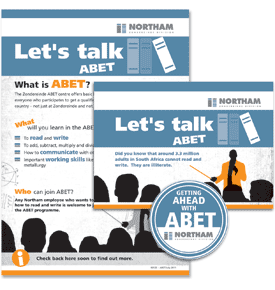
Marking the official opening of the new library and the re-launched of ABET at the end of October 2011 Zondereinde mine initiated the ‘Let’s talk ABET’ campaign. This campaign is aimed at encouraging current employees with a focus on those who dropped out in the past, to participate in ABET. The campaign is directed at informing employees of the benefits of obtaining functional literacy including inclusion in learnerships and apprentice programmes, and further training and study assistance.
Bursaries and study assistance programmes
A bursaries and study assistance programme (assistance to employees who are employed by the company, including in-service bursars) is based on the skills required by each department and is therefore department-driven. In F2011, Zondereinde provided support to 37 people, at a cost of R122 912, in the fields of mining engineering, electrical engineering, mechanical engineering, chemical engineering, metallurgical engineering, rock mechanics engineering, security management, human resources management and financial management.
At Zondereinde, Northam has in place the ‘Dinaledi Stars’ scholarship programme which provides assistance to local school girls in Grade 10 to 12. The top three students in Maths and Science in each grade are selected and bursaries to tertiary institutions of their choice are awarded to scholars once they matriculate. Each year, three new Grade 10 pupils are selected to feed the programme.
In addition, four bursaries are awarded to promising second year students from universities across South Africa until they complete their qualification. Northam is currently supporting four students in the fields of mining engineering, chemical engineering, electrical engineering and mechanical engineering.
Housing and living conditions
Zondereinde is currently reviewing and updating the effectiveness and appropriateness of the proposed housing strategy. A housing forum, comprising representatives of organised labour and management, has been established to actively direct the housing and living conditions objective of the company.
The requirements set out in the MPRDA underpin the overall intent and direction taken by Northam in respect of provision of housing and accommodation for employees and contractors.
A survey was conducted at Zondereinde in May 2011 to determine the needs and requirements of employees with regard to housing and living conditions.
The majority of Northam’s workforce come from laboursending areas and have indicated a clear preference not to be permanently housed in the area and will return home.
In F2011, 4 052 full-time employees (60%) were accommodated in hostels provided by the company, while some 1 914 employees opted to receive living-out allowances. Many employees have their primary homes and families in other countries, other provinces or other regions of Limpopo province. To deal with the continued need for hostels, the company is in the process of converting portions of the hostels into lower density accommodation.
Meals served at company-provided accommodation are prepared according to a meal plan drawn up by a clinical dietician with the energy, macro and micro nutrient content rigorously monitored. On average meals are served to around 5 932 people per day.
A tender has been awarded for the electrification of the Mojuteng housing project. An application to the local power utility to supply the houses with electricity was submitted three years ago and was granted in F2010. During the year, Northam engaged the services of a third party to assists with the overall project management and marketing of the project including the facilitation of access to finance so employees can purchase these properties. At present, 100 units are in use (see case study below).
Supervisory and management employees are largely accommodated in company-provided housing, which is a significant draw-card for employment in a country and region where there are housing shortages.
At Booysendal, full-time employees receive living-out allowances. Accommodation and meals are provided to contractor employees by the relevant contractors.
Home sweet home: Northam's Mojuteng home ownership scheme
Most people would like to buy their own home at some stage of their lives. Employees at Northam Platinum are no exception. In recognition of this fact, it is part of Northam’s accommodation and housing strategy to promote affordable housing and home ownership.
In the second quarter of 2010, Northam approached Chartwell Housing Finance Solutions (Pty) Ltd, a company specialising in housing schemes, to develop a plan that would give employees in salary grades 2 to 8 the chance to buy a house in the nearby Mojuteng township and start investing in their future.
The scheme that Chartwell designed for Northam focuses on making home ownership affordable and sustainable. It does this by offering employees not just a home loan, but a debt consolidation facility and a structured housing subsidy. This helps free up disposable income and results in higher loan approval rates – around 70%.
When employees apply for their home loan, a detailed discussion takes place on their budget and spending habits and the financial implications of becoming a homeowner are explained. A comprehensive credit scorecard, tailored to the mining sector, is used to ascertain whether an employee might become financially over-stretched by buying a home in Mojuteng.
Once employees receive approval for their home loans, they are invited to attend HomeWise, Chartwell’s two-hour, homeowner education programme. In the programme, employees learn about the rights and responsibilities of home ownership and about the credit agreement they are about to sign. Participants receive helpful literature to take home. After successfully completing the HomeWise programme, employees are invited to sign their credit agreement with the attorney.
The Mojuteng project has been branded and a fullscale marketing campaign launched. Billboards have been erected, information leaflets are available and a furnished showhouse has been opened. A newsletter, the Mojuteng News, is published to keep employees informed about the project. A One Stop Shop has been set up near to mine hostels, where employees can get information about Mojuteng and apply for their home loan. The One Stop Shop is run by a qualified estate agent, supported by an administration team. The team is on-site full-time and is multilingual.
For those employees who have already moved into their own homes in Mojuteng, a garden competition is being run with cash and garden vouchers as prizes.
As of June 2011, 109 units had been sold in Mojuteng, some 28% of the total number of units available. With such a wonderful opportunity on offer, the remaining 72% are unlikely to display “For Sale” signs for too much longer.