![Go to home page [Northam logo]](images/logo.png)



SAFETY, HEALTH AND EMPLOYEE WELL-BEING
Safety
Key performance indicators – F2011
- Five fatalities (F2010: one)
- FIIR of 0.06 per 200 000 hours worked, rising from 0.01
- LTIIR of 1.34 per 200 000 hours worked, rising from 0.83
- 28 shifts lost as a result of section 54 stoppages
Management approach
Extensive legislation and regulation guides safety and health practices and processes in the workplace, the most significant being the Mine Health and Safety Act. Northam has a safety and health policy in place at Zondereinde, and recognition agreements with organised labour that provide the context for its implementation.
The general manager holds ultimate responsibility for safety and health at both Zondereinde and Booysendal. At Zondereinde day-to-day management of safety is delegated to operational management, who are in turn supported by a mine-based safety and health department.
As required by the Act, emphasis is placed on the joint direction of safety and health. A joint management/ union health and safety committee meets on a monthly basis, or more frequently when required. The committee is charged with:
- identifying critical issues that hamper safety and health performance;
- the provision of personal protective equipment;
- participating in inspections, audits and accident investigation; and
- identifying areas for training and education.
A particular role of the committee is to empower employees to take responsibility for safety and health, to identify potentially hazardous situations and to encourage employees to exercise their right to refuse to work when conditions are not safe.
Around 85% of the company’s workforce is affiliated to a representative union and, through the union structures, participates in planning for and management of safety and health issues through their elected health and safety committees. Further, employees and management are encouraged to participate in safety and health matters at all levels.
While employees of Northam at Booysendal are currently not affiliated to a union, a safety, health and environment (SHE) committee, consisting of contractor representatives guides and monitors SHE performance. All employees, including those employed by contractors, receive safety standards and safety induction training.
Performance F2011
Ensuring the safety of employees and contractors is a primary area of focus for the company and takes precedence over any production objectives. It is very disappointing to report that safety performance at Zondereinde mine deteriorated significantly during the year under review with all indicators showing significant deterioration. This performance has interrupted the declining trend in safety performance over the past 10 years.
It is with deep regret that Northam reported five fatal accidents at Zondereinde mine in F2011 (F2010: 1). The board and management extend their sincere condolences to the families and loved ones of:
- Mr Avelino Domingos Cossa and Mr Samussone Rafael Chithango who died on 20 July 2010 following a fall of ground accident;
- Mr Alberto Antonio Bila who died on 9 January 2011 following a tramming accident;
- Mr Sonwabile Sululu Siyema who died on 2 June 2011 who suffered fatal injuries while engaged in water jet cleaning operations; and
- Mr Skaluko William Nhlapo who died on 7 June 2011, following a tramming accident.
Zondereinde mine’s fatal injury incidence rate (FIIR) was 0.06 per 200 000 hours worked (F2010: 0.01). The lost time injury incidence rate (LTIIR) was 1.34 per 200 000 hours worked (F2010: 0.83), and the reportable injury incidence rate (RIIR) was 0.74 per 200 000 hours worked (F2010: 0.52).
During the year, the severity of injuries continued to increase with the primary causes of lost time injuries occurring as a result of materials handling incidents (46%), drilling equipment injuries (14%) and falls of ground (11%). These statistics indicate that the number of injuries sustained as a result of at-risk behaviour remains very high. In F2011, 4 234 shifts were lost due to occupational injury (F2010: 1 881).
In total, five Section 54 instructions were issued by the DMR to close certain mining areas so that investigations could be carried out into the cause of each accident or safety infringement and to establish remedial actions to prevent similar incidents in future. On each occasion, management presented the findings of the investigations and remedial actions to the DMR. In total, 28 shifts were lost across the mine as a result of DMR-imposed safety stoppages. In addition, Zondereinde mine instigated 145 internal safety stoppages and employees are actively encouraged to exercise their right to refuse work if conditions are not safe.
During the year, Zondereinde mine continued the implementation of the ‘Stop and Fix’ programme. Regular inspections of working areas were carried out by team leaders and management. Employees were instructed to stop mining activities and fix the problem before continuing work in areas where irregularities were identified during these inspections. In all instances, employees were required to investigate the cause of the incident and present remedial action plans to rectify the situation, to the safety committee.
No fatalities occurred at Booysendal during the year. The LTIIR was 0.65 per 200 000 hours worked and the RIIR was 0.22 per 200 000 hours worked.
No shifts were lost as a result of DMR-imposed safety stoppages. Safety toolbox talks and safety officer meetings are held on a regular basis while daily on-site inspections are performed by management to increase visibility of supervision.
Health
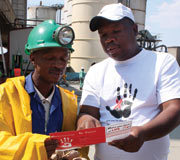
Key performance indicators – F2011
- emphasis on integrated wellness programme
- 18 cases of NIHL identified (F2010: 9)
- 93 new cases of TB identified (F2010: 119)
- 577 employees on ART (F2010:434)
Management approach
At Zondereinde, Northam offers an integrated and comprehensive health care service to all employees through the medical service provider, Platinum Health, which operates facilities on site at the mine and in the nearby employee village. All services are offered free of charge to all employees who contribute to the Platinum Health Scheme. Occupational health and medical emergency facilities are available to all employees and contractors.
In addition to medical services offered, Zondereinde has a comprehensive TB and HIV/AIDS management programme in place, which is also administered by Platinum Health. A mine-based HIV co-ordinator is responsible for the information and awareness aspects of the TB and HIV/AIDS programme.
Health care services at Booysendal are also offered to Northam employees, contractors and their dependants through the Platinum Health subsidised scheme. Facilities are located in Mashishing and at the Lion medical station near Steelport. Booysendal is currently in the process of developing a comprehensive TB and HIV/AIDS management programme which will also be administered by Platinum Health.
Employee well-being
Northam recognises that the well-being of employees extends beyond occupational health care and consequently, the focus of health care at Zondereinde has been increasingly extended to include other health issues which have an impact on the well-being of employees such as malaria, TB, hepatitus B, hypertension and diabetes.
The extent to which other health issues will be addressed at Booysendal will increasingly be extended as operations progress towards steady-state production.
Northam runs a highly-effective Directly Observed Treatment (DOT) regime for the treatment of TB at Zondereinde. This regime is aligned to the World Health Organization (WHO) guidelines. At year end, 162 employees participated in the company’s wellness programme.
Performance F2011
Zondereinde’s integrated and ongoing medical surveillance programme is well-established. In addition to general health screening and as a preventative measure, the programme identifies and monitors the incidence of noise-induced hearing loss (NIHL), pulmonary tuberculosis (TB), and occupational lung disease (OLD).
During the year, 10 528 (1 484 entry, 926 exit and 8 118 annual) medical surveillance examinations were performed at Zondereinde during the year and 1 560 (1 427 entry, 77 exit and 56 annual) at Booysendal.
The use of hydropower for underground mining activities, particularly for powering rockdrills, significantly reduces the level to which Zondereinde employees are exposed to noise and also helps reduce dust generation. The rock mass at Zondereinde does not contain quartz, thereby mitigating the threat of silicosis.
Noise levels associated with underground equipment is now contained below 110dBA. In addition, all employees are issued with personal protective equipment (PPE) to ensure that any exposure to noise levels above 85dBA over an extended period of time is limited. In F2011, 18 new cases of NIHL were identified (F2010: 9). On the face of it this appears to be a significant deterioration, but reflects the effects of exposure to an ageing workforce, many of whom would have been previously exposed to excessive noise levels at other mining operations. None of the cases identified were found to be compensable (F2010:2).
Northam recognises the health care burden presented by pulmonary tuberculosis (TB) and active programmes are in place to address this epidemic. The symbiotic relationship between TB and HIV exacerbates the incidence of both illnesses. In F2011, 93 new cases of TB were detected at Zondereinde, an 11% decrease from the previous financial year (F2010: 119).
Owing to the high virgin rock temperature (VRT) at Zondereinde (ranging between 51.4°C and 69.8°C), all employees are required to undergo heat tolerance testing on an annual basis which forms an important pre-emptive means of addressing the heat burden.
HIV/AIDS
Northam’s HIV/AIDS policy, adopted by the company in F2005, provides for the care of employees, education programmes, confidentiality of information and non-discrimination.
All employees have access to voluntary counselling and testing (VCT) programmes, anti-retroviral therapy (ART), as well as professional counselling and support. The Northam HIV/AIDS programme is focused on the following priorities:
- persuading employees who are HIV negative not to participate in high-risk behaviour, through education and awareness programmes, mass distribution of condoms, treatment of sexually transmitted infections (STIs) and a peer education programme;
- early detection and identification of HIV to limit high-risk behaviour amongst those infected and to start them on a treatment regimen that can prolong their healthy lives. The VCT programme underpins this objective and provides the necessary counselling; and
- persuading infected employees to participate in the wellness programme, that includes the provision of ART. Comprehensive counselling is in place to ensure that employees understand and accept the long-term implications of moving onto the ART programme.
Following on from the success of the highly visible VCT campaign initially introduced in F2010 to encourage employees and community members to know their status, another awareness campaign was launched in F2011, based on the company’s commitment to the three Cs which are: Consent, Counselling and Confidentiality. As a result, 1 618 employees (17% of the total workforce, including contractors) were tested (F2010: 1 840 employees, including contractors). In total, 577 (F2010: 434) employees are currently on the ART programme.
Peer educator systems at Zondereinde
At Zondereinde, Northam runs a peer education programme that is not only focussed on HIV/AIDS, but the company’s overall wellness programme and is aligned to the South African Government’s HIV/AIDS and Sexually Transmitted Infections National Strategic Plan and the Department of Health’s National Health calendar.
The peer educator group – comprising 16 employees – supports the company’s wellness programme which offers access to VCT, provides ART and professional counselling and support to employees by creating awareness through word of mouth and distribution of educational materials amongst employees and surrounding communities, including the Setaria village (the mine village), the towns of Northam and Thabazimbi and the Smash Block informal settlement.
Malaria
Although Northam’s operations are not located in areas in which malaria is endemic, many of the company’s employees have their primary homes in countries where this is the case. As a preventative measure, prophylaxis is provided to employees who return home to these areas and treatment is provided to employees who contract the disease.