![Go to home page [Northam logo]](images/logo.png)



ENVIRONMENTAL PERFORMANCE
Key performance indicators
- Energy usage – 601 890MWh
- Energy saved – 8 068MWh
- Water used – 4 832 000m³
- Water recycled – 91%
- SO2 emissions – 6 374 tonnes
- CO2e emissions – 635 401 tonnes
Management approach
As a PGMs development, mining and beneficiation company, Northam recognises that its activities have an impact on the land, water, air and natural resources including fauna and flora, in the areas which surround its operations. The existing Zondereinde mine and metallurgical complex has a sustained track record of sound environmental performance. At Booysendal, baseline assessments and planning to minimise the operation’s impacts on the natural environment have been concluded, with all required permits and licences having been awarded. Environmental management systems are currently being put in place to meet the obligations set out in these.
The health, safety and environmental committee has been tasked by the Northam board to oversee environmental matters at a group level. Environmental issues are considered on a quarterly basis by management committees at Zondereinde and Booysendal and reported to the CEO.
Environmental management at Zondereinde mine
Environmental issues are managed as an integral part of the production process at Zondereinde. Owing to the technical nature of so many of the environmental issues and challenges, this portfolio falls under the engineering department and, specifically, the engineering manager who is supported by an environmental officer. Ultimate responsibility for environmental compliance and performance, however, lies with the general manager of Zondereinde and the chief executive of Northam.
Environmental management at the Booysendal project
At Booysendal, oversight for environmental issues within the designated mining area (1.3% of land under management) is the responsibility of the general manager of that site, supported by environmental personnel, in line with environmental permitting and systems. The balance of the land under management will fall under the responsibility of a land manager with a background in conservation rather than mining.
Key environmental issues and parameters for both operations are formally reported on a monthly basis to the mine and company executive and on a quarterly basis to the SHE committee of the board.
Legislation and compliance
Rigorous environmental and mining legislation governs environmental impacts and permitting in South Africa, including:
- the MPRDA;
- the National Water Act;
- the National Environmental Management Act;
- the Air Quality Control Act; and
- The National Waste Act.
The new Air Quality Control Act came into full effect in April 2010 and has ramifications for emissions, particularly for the reporting of industrial greenhouse gas (GHG) emissions data and mitigation plans. Government is developing additional legislation on the actual reduction of GHG emissions (34% below the business as usual baseline by 2020 and 42% below the business as usual baseline by 2025).
Northam manages it operations in line with the environmental legislation and regulations of, in particular, the Department of Mineral Resources (DMR) and the Department of Water Affairs (DWA).
Consultation is also held with the regulatory authorities. The company did not receive any environmental fines or legal sanctions during the year under review.
Implicit within the regulations of NEMA and Northam’s own EMS’s is the adoption of the precautionary approach.
The Zondereinde mine was granted a new order mining right by the DMR during F2011, having applied for conversion of its old order mining rights in 2006. Zondereinde’s water use licence is still outstanding, and the mine operates in terms of an exemption from the DWA. Northam understands that a significant number of mining companies are in a similar position and that the delays relate to a processing backlog. The company has been advised by the department that it should continue to act in line with its previous permit requirements until such a time as a new permit has been issued. The Booysendal operation was allocated its integrated water use licence (IWUL) on 17 May 2011.
As required by legislation, environmental management plans (EMPs) are in place at both the Zondereinde mine and the Booysendal project. These plans aim to address the impacts and potential impacts on the environment by Northam’s operations as well as the measures to manage, monitor and mitigate these impacts. According to South Africa’s environmental legislation, all new mining projects are subject to environmental impact assessments (EIAs) which include a high degree of public participation as well as numerous specialist studies which cover all aspects of the environment including fauna, flora, archaeology as well as water and air quality.
ISO 14001
Northam has adopted the ISO 14001 as the basis for its environmental management systems. The Zondereinde mine was awarded ISO 14001 certification for the Zondereinde mine on 28 February 2011, in line with following the completion of a three-year project to implement this stand at the mine and metallurgical complex. The implementation of ISO 14001 at the Zondereinde metallurgical complex is currently underway, and the company is targeting certification by (2014).
A revised environmental management programme (EMP) and training model was developed during the year, and is being implemented.
The principles underlying ISO 14001 have been incorporated into Booysendal’s EMP, with the aim of ensuring that an ISO14001-aligned EMS is in place when the mine reaches steady-state operation. ISO14001 certification will be sought thereafter.
There were no significant environmental incidents at Zondereinde during the year, and no significant water spillages during the year.
Performance F2011
Northam’s environmental impacts at Zondereinde and Booysendal are different given the stage of operation (development versus steady-state, nature of operation (deep level versus shallow mining) and location. Generally, however, these impacts can be categorised as:
- the use of resources, including rock mined, water and energy and other material consumption;
- emissions and discharges to water, land and air;
- management of land, including rehabilitation and biodiversity management; and
- planning for and funding of eventual rehabilitation and closure.
Resource utilisation
The primary resources used by Northam are water, energy and bulk materials such as rock (mined and processed), liquid fuels, coal, grease, steel, timber and lubricating and hydraulic oils. Zondereinde actively optimises its resource usage and recycling programmes are in place for plastics, steel, timber and scrap.
| Unit | F2011 | F2010 | |
|---|---|---|---|
| Rock mined | 000t | 1 801 | 2 281 |
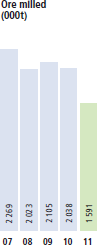
| Ore milled | 000t | 1 591 | 2 105 |
| Timber | m³ | 754 | 3 528 |
| Cartridge explosives | t | 2 010 | 2 650 |
| Oxygen | t | 2 461 | 3 131 |
| Sulphuric acid | t | 747 | 1 064 |
| Sulphur dioxide | t | 90 | 122 |
| Grease | t | 41 | 61 |
| Lubricating and hydraulics oils | l | 112 311 | 125 034 |
| Unit | F2011 | F2010 | |
|---|---|---|---|
| Plastic | t | 62 | 14 |
| Steel | t | 1 759 | 1 508 |
| Timber | m³ | 5 874 | 6 402 |
| Scrap metal | m³ | 2 526 | 2 557 |
| Rubber | t | 156 | 168 |
Water
Northam recognises that water is a scarce resource and is committed to optimising its usage. Northam has considered the risks and opportunities relating to water availability in its voluntary submission to the Carbon Disclosure Project (CDP) Water Disclosure for the second consecutive year. Northam’s response to CDP water Disclosure may be downloaded from http://www.greenbiz.com/sites/default/files/CDP-2010- Water-Disclosure-Global-Report.pdf.
Water is fundamentally important for Zondereinde mine, not just from an environmental and permitting perspective, but also because the mine uses water as its primary source of energy for underground operations through a shaft-based hydropower system. Water management and water quality are therefore an integral part of the management of all Northam operations.
At Booysendal, water allocation too, is of critical importance. Construction operations at Booysendal have been fast-tracked following the allocation of the water use licence in May 2011.
Two primary water sources contribute to the total water used at Zondereinde. These are:
Industrial water
Industrial water is used for all mining and processing operations; it constitutes around 90% of total water usage on an annual basis. This water is maintained within a closed circuit and recycled on an ongoing basis.
Evaporation rates are high given the geography and climate of the region, where surface temperatures may reach as high as 40°C in summer. The water is exposed to evaporation while it is contained within the processing facilities, on the tailings dams and storage facilities, and needs to be supplemented by 10% on an annual basis.
There has not been a significant change in the rate of water flow as a result of mining operations over the 20 years (since mining first started at Zondereinde).
The fissure water flow is not seasonal which is a clear indication that this water is distinct from rechargeable groundwater.
Zondereinde does not source water from riverine systems, surface sources or from perched aquifers (in other words, groundwater). The balance of surface water make-up comes from rainfall onto the property which is captured in the dams, and which by definition becomes grey water.
Potable water
Around 10% of the total daily water usage at Zondereinde is potable water purchased from the Magalies Water Board on an annual basis.
As the company’s operations are located in an area where water is considered a scarce resource, Northam recognises that water availability may in future be constrained as a result of increasing industrial pressure on water supply and as a result of climate change, and therefore needs to be conserved.
While Zondereinde does not consume water from local sources or has an impact on them, it remains an active participant in matters relating to water management in the area by way of, amongst other approaches, discussing water issues with local community members and farmers whose properties surround the company’s operations. On an annual basis, Zondereinde hosts an open day whereby all interested and affected parties are invited to air any issues they may have. Zondereinde is a participant within the Crocodile River and Groot Marico Catchment Management Authorities.
When overflow is inevitable due to heavy and sudden rainfall, discharge conditions are monitored and discharge is carried out from the treated sewerage effluent dam and evaporation dam into the Bierspruit. During the year, this occurred on one occasion as a result of heavy rainfall during the months of January to March and was done in strict compliance with permit conditions.
Sampling of underground and surface water at Booysendal was finalised during F2010 with the qualified data providing base line information on the original water quality in the area. Water quality at Booysendal is monitored on a continuous basis and the findings compared with base line information, compiled during a sampling of underground and surface water exercise during F2010, to determine and remediate any miningassociated impacts on the water system.
Zondereinde endeavours to run a zero discharge operation and closely monitors any potential impact of its operations on surface and groundwater sources. Extensive monitoring is undertaken and a comprehensive groundwater model, developed and maintained by a third party consultant, has been in place for six years. This consultant also monitors and advises on surface and groundwater quality control.
Sampling of underground and surface water at Booysendal was finalised during F2010 with the qualified data providing base line information on the original water quality in the area.
Water quality at Booysendal is monitored on a continuous basis and the findings compared with base line information, compiled during a sampling of underground and surface water exercise during F2010, to determine and remediate any mining-associated impacts on the water system.
| F2011 | F2010 | |
|---|---|---|
| Potable water from external sources | 2 441 | 2 601 |
| Fissure water used | 2 392 | 1 385 |
| Water recycled in process | 24 308 | 23 439 |
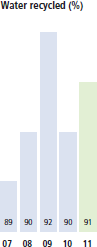
| % water recycled | 91% | 90% |
Energy

Mining activities at the Zondereinde mine are carried out by hydropowered equipment, a technical innovation pioneered and refined over time by Northam. Hydropowered equipment is used for direct mining operations and provides the added advantage of positional cooling where work is performed. A second technological innovation used by Northam, is the use of backfill to support mined underground areas. Backfill lowers the underground temperatures by reducing heat ingress from worked-out areas, while also reducing the size of the area to be cooled by 65%.
Northam estimates that annual savings on electrical energy as a result of using hydropowered equipment and backfill are in the order of 190 399MWh and 50 400MWh respectively. This is a large saving, considering that, during F2011, electricity accounted for 10.4% of total operation costs. The National Energy Regulator of South Africa (Nersa) approved a nominal power tariff increase of 25.8%, which came into effect on 1 April 2011, and a subsequent increase of 25.9% for 2011/12 and 2012/13 respectively.
Owing to the extensive use of hydropower at Zondereinde, Northam continues to be presented with an economic advantage due to the fact that the company uses less electricity than its shallower (in South African platinum mining terms) peers. In addition, the company’s experience of using an alternative source of energy has resulted in the establishment of a culture and infrastructure which forms a platform from which further renewable energy innovations may be developed in the short to medium term.
Given Northam’s existing relatively low base of energy consumption at its mining operations and the likelihood of increased energy consumption at Zondereinde as a result of extending the mine to greater depths to maintain production and the ramping up of production at Booysendal, Northam will not be able to reduce energy consumption going forward.
Total indirect non-renewable energy consumption from electricity sourced from Eskom at Zondereinde decreased by 6% to 601 890MWh (2 166 804GJ) in F2011 (F2010: 639 740MWh (2 303 064GJ)) with around 77% of electricity used by processing and smelting activities and23% by mining operations.
| F2011 | F2010 | |
|---|---|---|
| Energy from electricity purchased by shafts | 461 484 | 483 541 |
| Energy from electricity purchased by plant | 140 406 | 156 199 |
| Total electricity purchased | 601 890 | 639 740 |
| F2011 | F2010 | |
|---|---|---|
| Energy from electricity purchased by shafts | 1 661 342 | 1 740 748 |
| Energy from electricity purchased by plant | 505 462 | 562 316 |
| Total electricity purchased | 2 166 804 | 2 303 064 |
* Northam reports on its electricity consumption in MWh. In some instances these figures have been converted to GJ as requested by GRI.
Northam continues to benefit from the renewable energy and energy conservation scheme implemented at Zondereinde mine together with Eskom in F2010 Seven energy saving projects have been implemented and it is estimated that this has resulted in a 8 068MWh saving on the total energy consumption from electricity purchased in F2011.
These energy saving projects include:
- the roll-out of compact fluorescent lighting and geyser blankets to mining staff and Setaria village residents;
- the modification of electrical geysers to solar power;
- the use of hydropowered equipment for drilling, cooling and cleaning operations;
- the use of backfill to support mined areas which also reduces heat ingress and has resulted in a 65% decrease in the size of the area which needs to be cooled;
- the use of Power Factor Correction equipment which reduces the electrical load and minimises wasted energy, therefore improving efficiency while reducing the electricity bill; and
- the conversion of mast and street lighting to energy saving lights.
At Booysendal, optimisation studies undertaken in F2010 resulted in a revised mine design and higher rate of production at full capacity, which may result in electricity consumption exceeding the initially allocated 20MVA during peak demand times. These requirements will be fulfilled by self-generation of power on site (5MVA) during peak times.
The revised design also makes provision for an energy management system, which is still to be formally approved by Eskom, and the introduction of energy recovery strategies. Orepass capacity has been improved which will minimise the requirement for decline conveyors to run during peak shift times. In addition, cycle efficiencies and optimised equipment selection will maximise output in each section, and at the same time reduce the number of sections required to operate, and so reduce energy requirements.
Climate change
Climate change presents moderate risk for Northam on a physical and regulatory front. However, climate change also presents an opportunity as PGMs are used in technologies that bring about reduction in noxious gases. Indeed, the global trend of tightening emissions legislation continues to stimulate the use of PGMs in autocatalysis.
Northam has considered the risks and opportunities relating to climate change, including its financial implications in its voluntary submission to the Carbon Disclosure Project (CDP) for the third consecutive year. Both physical and regulatory risks have been identified and the company continues to manage these primarily through its energy conservation initiatives. During the year under review the company will, in partciular, be considering issues relating to adaptation, and the impact of climate change on its communities. Northam’s submission to the Carbon Disclosure Project’s 2011 annual survey may be found at: www.cdproject.net.
The most significant emissions or potential discharges from Zondereinde are SO2 emissions (directly from the smelting operations) CO2 emissions (direct and indirect), potential discharges to water courses and dust generation from tailings dams.
CO2 emissions
Progress towards the development of a company climate change mitigation strategy has been made with Northam already reaping the benefits of a number of energy saving and efficiency projects to reduce electricity consumption and therefore the amount of greenhouse gases (GHGs) admitted into the atmosphere (as the bulk of Zondereinde’s CO2 emissions are largely attributable to indirect emissions from electricity purchased from Eskom).
| F2011 | F2010 | |
|---|---|---|
| Total global Scope 1 emissions (direct emissions) | 14 432 | 16 796 |
| Total global Scope 2 emissions (indirect emissions) | 619 947 | 658 932 |
| Total global Scope 3 emissions (indirect emissions) | 1 089 | 1 388 |
| Total emissions | 635 468 | 677 116 |
SO2 emissions
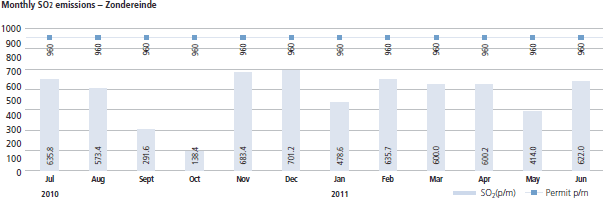
In total, 6 374 tonnes of SO2 was released into the atmosphere from the Zondereinde smelting facility (F2010: 6 853 tonnes per day) which translates into an average of 17.5 tonnes per day (F2010: 18.8 tonnes per day). Northam’s current permit allows for an average of 32 tonnes per day.
SO2, also known as Sulphur dioxide is a dangerous air pollutant because of its corrosive properties and is produced by combustion of coal, fuel oil and petrol. SO2 emitted into the atmosphere acts as an aerosol which means that billions of small particles form a layer in the Earth’s atmosphere preventing heat from escaping, resulting in the retention of heat and contributing to global warming and climate change. In addition, SO2 is ultimately converted into dilute sulphurous acid, returning to the Earth’s surface in the form of acid rain which contributes to the acidification of lakes and streams, accelerated corrosion of buildings and reduced visibility.
Dust management
During F2011, Zondereinde mine implemented a ground level air pollution concentration model. Dust is monitored on a regular basis and interested and affected parties are encouraged to lodge any complaints relating to dust emissions from the tailings dams on an ongoing basis and at the environmental open day hosted by Zondereinde. To date, no complaints have been received.
At Booysendal, monthly dust deposition monitoring conducted during F2010 has provided baseline information on the dust levels in the area before mining had commenced. Northam continues to monitor dust deposition in the areas adjacent to the Booysendal project to determine the level of impact of mining activities on the area and to develop dust mitigation procedures to reduce its impact on the area.
Land management and biodiversity
Northam recognises that it has an important role to play in the custodianship of the land on which its operations are located. By its nature, and the fact that it is longestablished, the management of land and the conservation of biodiversity at Zondereinde mine and metallurgical complex is far simpler than at Booysendal.
None of Northam’s activities are situated in areas protected by the World Conservation Union, heritage sites or biosphere reserves and no Red Data species have been identified on or adjacent to both mine properties. It is recognised, however, that Booysendal is located in a more remote and pristine environment that needs to be safeguarded for future generations.
Land management at Zondereinde
Zondereinde’s landholding is far greater than the actual surface footprint of the complex, with surface freehold covering some 4 439 hectares.
Of the land under management, only 137 hectares (3%) has been disturbed by mining, processing, deposition and related activities, including the mine village. The tailings dam and waste rock dump account for around 281 hectares – or 6.3% of the Zondereinde landholding. Land leased to farmers covers 273 hectares (6%) of the total area, while Northam maintains 800 (18%) hectares for conservation and biodiversity purposes. The balance of the land (73%) remains in its natural state.
Zondereinde’s tailings storage facility (TSF) will be rehabilitated as deposition continues to reduce dust levels and for aesthetic reasons with final rehabilitation only occurring after closure.
| Land disturbed by mining and related activities | 137 |
| Land leased for farming purposes | 273 |
| Land protected for conservation | 800 |
| Total land under management (freehold) | 4 439 |
Land management at Booysendal
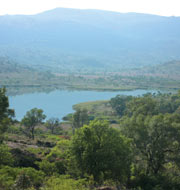
Given that Booysendal is located in a biodiversitysensitive region – the Der Brochen valley - the company has developed a unique and progressive structure that will see oversight of land under management as a distinct and equal role to that of the management of the mine.
At Booysendal, Northam’s mining right covers an area of 15 151 hectares over which the company owns freehold of 7 423 hectares. Of the land under management, around 100 hectares has been disturbed by mining related activities with around 800 hectares of the landholding having been set aside for conservation and biodiversity purposes.
Booysendal is in the process of establishing a trust to be funded during the life of mine for the active promotion of conservation in a proposed offset area.
Booysendal platinum mine and environmental responsibility
Northam Platinum’s new Booysendal mine, falls within the Sekhukhune Centre of Plant Endemism (SCPE), an area of some 5 500km². Nearly half of the SCPE lies within the province of Mpumalanga.
A centre of endemism has at least 50% of plant species confined to that centre, and is generally considered to include more than 1 000 endemic species. Not only do these centres hold clues to the origin and evolution of the botanical diversity of an area, but these are also areas that, if conserved, would safeguard the greatest number of plant species. Furthermore, these areas also have the potential to include new or cryptic plant or animal species as yet undescribed and undiscovered.
The SCPE has been classified as irreplaceable in the conservation plan of the Mpumalanga Tourism and Parks Agency (MTPA). Furthermore, it has been identified that, within Mpumalanga, the SCPE area is not formally protected within any nature reserve and that more land needs to be incorporated within nature reserves to protect the province’s biodiversity.
To further highlight the ecological importance of the area, the majority of the Booysendal mine is in the Roossenekal sub-centre of the SCPE. This sub-centre is described as a 1 000km² area that is a unique ecotone or zone between the Highveld and Lowveld of South Africa. The area is characterised by undulating norite (coarsegrained igneous rock) hills. A total of 30 SCPE endemic plants are listed in the Roossenekal sub-centre, with six of these only being present in the sub-centre. Within the sub-centre there are also 32 near endemics.
Little wonder that the great environmental responsibility placed on the shoulders of Northam Platinum should result in the mining company taking far-reaching steps to act as punctilious guardian of this special area.
As a result:
- All environmental work undertaken in the mining area is based on the best scientific information available and a comprehensive biotic survey of the entire area has been undertaken;
- A qualified land manager, has been appointed and is answerable directly to the CEO of Northam;
- Land has been purchased and the creation of an offset area is in progress, with an ecological management plan according to best management practice being devised for it;
- Land management will support the goals of the MTPA. One of the greatest threats to biodiversity within Mpumalanga is the invasion of natural areas with alien vegetation, and its centres of endemism have been identified as areas that should receive priority in clearing programmes. Hence, Northam is undertaking extensive clearing of alien vegetation;
- A trust fund is being established with an initial R10 million and contributions of US$1/oz Pt. The trust will be responsible for creating continuity of funding, managing and expanding the offset areas and funding research and conservation projects.
Biological surveys undertaken at Booysendal have rediscovered a population of the thought to be extinct giant cicada, Pycna sylvia. It is good to know that, as a result of Northam’s integrity in the area of environmental responsibility, Pycna sylvia’s future is secured.
Planning for closure
During the year under review, Northam commissioned a performance assessment for the verification of compliance to the Zondereinde EMP by a third party.
The performance assessment included the verification of compliance to other permits and licences, including its landfill site permit, water permit conditions and its air emissions certificate. Overall findings indicate that the site is managed according to environmental best practice and complies with the commitments made in the initial EMP and the requirements of its water permit, air emissions certificate and associate amendments.
A few minor observations were made which the mine is currently implementing.
At the end of June 2011, Northam’s total environmental liability was estimated at R107.3 million (F2010: R65 million). As prescribed by law, the company has a rehabilitation trust fund in place, valued at R29 million at year end.
The Booysendal operation submitted a three-phased rehabilitation plan to the DMR in F2010 following the completing of planning for closure. Furthermore, Northam has lodged a guarantee with the DMR to the value of R66 million to provide funding to cover the cost of the first five years of the project.