

- Print this page
- This page as PDF (249KB)
Social performance
- Safety, health and employee well-being
- Employment and human rights
- Northam in the community
- Product responsiblity
- 9 042 people employed*
- 8% turnover rate*
- 7% women in mining*
- 33% HDSAs in management*
- 84% of employees represented in collective bargaining forums*
- R50 million spent on training and development
Northam strives to be a fair employer, providing decent work, in an environment that allows employees the opportunity to develop their skills and grow.
Management approach
The management of the people of Northam is the responsibility of the general manager of the Zondereinde mine and the chief executive of the company. A small Booysendal project team has been appointed, and is headed up by the Booysendal general manager.
While the management of people is a line management function, extensive support is provided by the mine-based human resources department. In addition to core administrative functions, this department is also responsible for:- training and development at all levels;
- recruitment and retention of employees;
- employment equity programmes;
- labour relations, including collective bargaining;
- compliance with the Mining Charter in respect of human resources development; and
- planning for change and provision of training for career endings.
Overall oversight is provided by the remuneration, nomination and employee equity committee of the board. This committee, in consultation where necessary, with management, ensures that the group’s employees are fairly rewarded for their contribution to the group’s performance.
The group’s remuneration philosophy is to ensure that salaries and related benefits are competitive relative to other mining companies. Specifically, the committee, on behalf of the board, approves the employment contracts and remuneration packages of senior management, ratifies the appointment of senior management other than directors, and approves any short-term incentive schemes and bonuses, including the offer of options in terms of the rules of the Northam Share Option Scheme.
The committee approves the mandate with regard to negotiations with trade unions and oversees implementation of and compliance with the requirements of the Employment Equity Act and the administration of the group’s share incentive scheme.
Performance in F2010
Employment
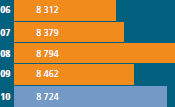
At the end of June F2010, Northam employed 9 042 people (6 862 employees and 2 180 contractors). The average employment number for comparable reporting purposes amounted to 8 724 during F2010. This equates to a 3% increase in the average number of employees from 8 462 in F2009. Once production at Booysendal reaches steady-state, it is expected that the group’s employment base will increase by a further 1 150 people.
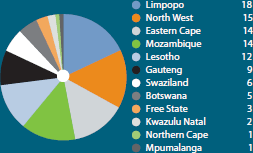
At the end of June 2010, 18% of permanent employees at Zondereinde were drawn from the Limpopo province, while a further 45% were from other provinces in South Africa, and an additional 37% (F2009: 47.3%) from neighbouring countries. The 10% decrease in migrant labour is an indication of the progress made in respect of increasing local labour representation although the company does not in any way discriminate against foreign labour.
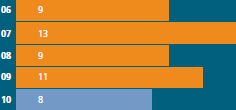
As at 30 June 2010, the turnover level at Zondereinde in F2010 was 8% (F2009:11%), with a total of 539 people leaving the employ of the company during the period. These departures were mainly as a result of dismissal (3%), resignation (4%), retirement (0.1%) and death (1%). No employees were discharged as a result of restructuring activities.
Human rights and collective bargaining
Northam upholds the basic labour rights enshrined in the Fundamental Rights Conventions of the International Labour Organization (ILO) relating to collective bargaining and ensures the implementation of fair employment practices by prohibiting forced, compulsory and child labour, and any form of discrimination based on race, religion, age, disability or political affiliation.
Northam supports employees’ rights to freedom of association and acts in accordance with the South African constitution, prescribed legislation, industry compacts and recognition agreements with unions. None of these rights are believed to be at risk within the company, and no incidents of human rights abuse were reported during the year. While discrimination was alleged on a number of occasions during the year, due process was followed in terms of the company’s disciplinary and dispute resolution mechanisms, and no cases were upheld.
The rights to freedom of association and collective bargaining are entrenched within South Africa’s legislation and the country’s constitution. Collective bargaining structures, policies and practices are embedded at all levels of operation, and ensure employment practices are fair and employees are represented appropriately. Minimum notice periods in respect of operational changes and rates of pay for men and women are prescribed by legislation.
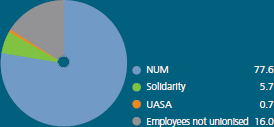
The greater part of the workforce (84%), is represented by a recognised union or through a collective bargaining agreement. The National Union of Mineworkers (NUM) continues to represent the bulk of employees (77.6%), while the remainder of unionised employees are represented by Solidarity (5.7%) and UASA (0.7%).
Conditions of service, including wages, are negotiated on an annual basis. Recognition agreements with unions also regulate aspects relating to participation in safety and health structures and disciplinary grievance procedures.
Northam insists that all contractor employees are treated in compliance with legislation and the company’s own policies. This is particularly so in respect of human rights issues such as collective bargaining, discrimination and access to fair employment practices and safe working conditions.
Employment practices
Northam is committed to fair and progressive employment practices, providing long-term employment opportunities with the scope for employees to develop to their own potential. Competitive remuneration practices take into account the nature of the operation, the innovative mining practices as well as the remote locations of its operations. Northam’s remuneration practices are well above the country’s legislative minimum wage requirements. Benefits provided to full-time employees include membership of pension and provident funds, death benefits, access to medical care, housing and living-out allowances, study assistance, maternity and paternity leave. Around 98% of employees participate in the fortunes of the company through the Toro Trust Fund which seeks to empower employees by providing a meaningful interest in the company’s future. (See economic performance section).
Remuneration and conditions of service for most employees (84%) are governed by collective bargaining structures that are negotiated bi-annually. For employees outside of these bargaining units, performance reviews are undertaken on an annual basis. Further, through the skills development programme, all employees’ skills development plans are reviewed on an ongoing basis.
Union representation at Zondereinde (%)
Average number of employees
Turnover rate – Zondereinde (%)
Employment equity
Northam has an employment equity programme in place that is guided by the requirements of the Mining Charter and the Employment Equity Act. A joint management/labour employment equity forum plays a major role in monitoring and implementing employment equity practices that promote the recruitment, development and retention of HDSAs, particularly in supervisory and management roles and core mining disciplines. A mentorship programme is in place to achieve the requisite levels of HDSAs and women in mining targets required by the Mining Charter with the progress of each employee reviewed on a quarterly basis.
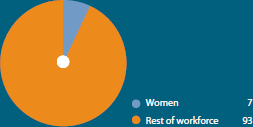
At the end of F2010, 33% of management positions were filled by HDSAs (F2009: 34%) and 5% by women. Women made up 7% of the workforce compared with 4% during F2009.
The company continues to report progress towards achieving the 10% level of representation of women in mining required by the Mining Charter, although a number of challenges remain. Focus groups are held on a quarterly basis to identify the major barriers to women in mining with issues relating to sexual harassment, housing and living conditions, and pregnancy having been identified as the major challenges.
A particular difficulty is experienced with retention of highly sought-after skilled women and HDSA employees. Programmes are in place to mitigate these challenges and to increase female representation at the workforce.
| Occupational Levels | Non‑foreign nationals | Foreign nationals | Total | ||
|---|---|---|---|---|---|
| Male | Female | Male | Female | ||
| Top management | 1 | 0 | 0 | 0 | 1 |
| Senior management | 12 | 0 | 0 | 0 | 12 |
| Professionally qualified & experienced specialists and mid management | 76 | 5 | 0 | 0 | 81 |
| Skilled technical & academically qualified workers, junior management, supervisors, foremen and superintendents | 562 | 47 | 35 | 0 | 644 |
| Semi-skilled and discretionary decision making | 1 783 | 108 | 1907 | 1 | 3799 |
| Unskilled and defined decision making | 1 516 | 284 | 564 | 2 | 2366 |
| Total permanent | 3 950 | 444 | 2 506 | 3 | 6903 |
Training and development
Northam continues to expand its employee skills base by means of an extensive skills development programme which includes Adult Basic Education and Training (ABET) to learnerships, on-the job training through a mentorship programme, the provision of bursaries and study assistance to potential and current employees and to the development of alternative skills to assist employees in the transition to retirement or separation from the company.
In F2010, each employee received around 45 hours of training (F2009: 72 hours on average) with training expenditure amounting to R50 million (F2009: R44 million) during the year.
In F2010, employees were invited to participate in a voluntary test to establish their level of literacy. Of those employees who participated, 67% were found to be functionally literate. ABET is available to all employees on a part-time, voluntary basis. At present, 500 employees can be accommodated per semester at the current ABET facility which comprises three computer rooms equipped with 100 computers and two facilitation rooms. A total number of 1 053 learners were registered to attend ABET during the year with 160 completing the curriculum and participating in examinations – 200 in the first half of the financial year, and 260 in the second half. The pass rate has improved dramatically as increased resources and attention have been allocated to ABET, from 21% in the first examination session to 51% in the second.
A performance management audit was conducted at the ABET facility during F2010, which resulted in the establishment of measures such as weekly progress and attendance monitoring to stem the drop-out rate of ABET learners. Two additional classrooms and a library will be constructed during the following financial year.
Bursaries and study assistance (assistance to employees who are employed by the company, including in-service bursars) provided support to 22 people, at a cost of some R334 704, in the fields of mining engineering, electrical engineering, mechanical engineering, chemical engineering, metallurgical engineering, rock mechanics engineering, environmental management, human resources management, financial management and security management.
A skills development plan to develop employees for specific career paths is in place, in alignment with the requirements of the Mining Charter.
Housing and living conditions
Northam’s accommodation and housing strategy is aimed at providing all employees with access to accommodation that meets certain minimum standards and, at the same time, to promote affordable housing and home ownership. The company wishes to reduce dependence on company-provided accommodation and discourages the growth of informal settlements. However, it also recognises that there are a certain number of employees who do not wish to relocate to the mine and wish to maintain their traditional homes in the areas from which they are drawn.
In F2010, 4 164 full-time employees (64%) were accommodated in hostels provided by the company, while some 1 534 employees received living-out allowances.
Many employees have their homes and families in other countries, other provinces or other regions of the Limpopo province. To deal with the continued need for accommodation and to comply with its commitment set out in the SLP, Northam has entered into consultation with all relevant parties regarding the improvement of standards of housing, including the upgrading and conversion of hostels into family units and promoting home-ownership options.
Supervisory and management employees are largely accommodated in company-provided housing, which is a significant draw-card for employment in a country and region where there continue to be housing shortages.
Significant resources have been put into developing a housing strategy for the period 2010 – 2014, making hostels, flats and family units available to all employees, the development of a continuous maintenance plan and building seven additional hostel blocks which will accommodate fewer employees per room to allow for lower density accommodation.
Meals served at company-provided accommodation are prepared according to a meal plan drawn up by a dietician with the energy, macro and micro nutrient content being rigorously monitored by the same contracted service provider. On average meals are served to around 3 216 people per day.
HDSAs in management (%)
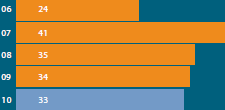
HDSAs in management (%)
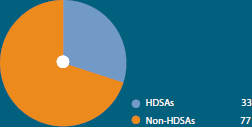
HDSAs at board level (%)
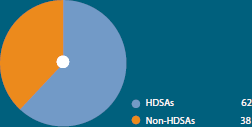
Women in mining (%)
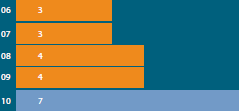
Women in mining (%)
Origins of employees (%)
NORTHAM SUSTAINABLE DEVELOPMENT REPORT 2010