

- Print this page
- This page as PDF (434KB)
Environmental performance

- Energy usage – 690 198MWh
- Fresh water usage – 3 985 211m3
- Water recycled – 86%
- SO2 emissions – 6 853 tonnes
- CO2e emissions – 677 116 tonnes
As a platinum mining and beneficiation company, Northam recognises that its activities have an impact on the land, water, air and natural resources including fauna and flora, in the areas which surround its operations. The existing Zondereinde mine and metallurgical complex has a sustained track record of sound environmental performance. At the Booysendal project, which is located in an environmentally sensitive area, the process of baseline assessments and planning to minimise the operation’s impacts on the natural environment began as part of the environmental permitting process.
Management approach
Management and oversight
Environmental issues are managed as an integral part of the production processes at Zondereinde. Owing to the technical nature of so many of the environmental issues and challenges, this portfolio falls under the engineering department and, specifically, the engineering manager, who is supported by an environmental officer. Ultimately, however, responsibility for environmental compliance and performance is the responsibility of the general manager of Zondereinde and the chief executive of Northam.
Key environmental issues and parameters are formally reported on a monthly basis to the mine and company executive and on a quarterly basis to the SHE committee of the board.
Legislation and compliance
Rigorous environmental and mining legislation governs environmental impacts and permitting in South Africa. This includes the MPRDA, the National Water Act, the National Environmental Management Act, and the Air Quality Control Act. The latter came into full effect on 1 April 2010 and has ramifications for emissions, particularly for the reporting of industrial GHG emissions data and mitigation plans. Government is developing additional legislation on the actual reduction of GHG emissions, by 2020, by 34% below the business as usual baseline and by 42% by 2025.
Northam operates in compliance with environmental legislation and the company has not received any fines or legal sanctions during the year under review.
It is noted, however, that Zondereinde has not yet been granted a Water Use Licence by the Department of Water Environmental Affairs (DWEA). Zondereinde’s water use permit expired in December 2005 and, although the company submitted a Water Use Licence application in June 2005, this licence has not yet been obtained. Northam understands that a significant number of mining companies are in a similar position and that the delays relate to a processing backlog. Northam has been advised by the department that it should continue to act in line with its previous permit requirements until such time as a new permit has been issued. In recent dealings, Northam has been advised that the issue of this licence is imminent.
ISO14001
Northam has adopted the ISO14001 environmental management standard as the basis for its environmental management systems and, in F2010, completed a three-year project to implement this standard at the Zondereinde mine and metallurgical complex.
A great deal of progress towards the implementation of ISO14001 was made during the year with the scope of Zondereinde’s environmental impacts being identified and rated in respect of key parameters. A first phase of compliance auditing was completed during F2010 with the second phase undertaken in August 2010 after the financial year-end. The first phase of the ISO14001 certification audit, which focuses on mining, will take place during September 2010. Once mining certification is obtained, Zondereinde will apply for metallurgical certification.
Zondereinde is in the process of implementing a revised Environmental Management Programme (EMP) for the mine and a training module has been developed which will be rolled out to employees during the following financial year.
The ISO14001 standard will be adopted by Booysendal. Northam has committed to its full implementation at this operation within the first year of steady-state operation.
Performance in 2010
The information below is presented for the Zondereinde mine as this is the company’s only currently operating subsidiary. Information pertaining to the Booysendal project is presented where this is appropriate and indicated as such.
Although the Zondereinde mine and metallurgical complex holds title to an extensive area of land, only a small part of this is under active management, and an even smaller component has been affected by mining and processing activities. As a deep-level underground operation, the mine’s surface footprint is small.
Two significant chemical spillage incidents occurred whilst chemicals were delivered to the chemicals storage facility at the refrigeration plant by a service provider at Zondereinde. The affected area was cleaned and more stringent control measures were implemented.
Northam’s environmental impacts are reported under four headings, namely:
- use of resources, including the rock mined, water and energy and other material consumption;
- emissions and discharges to water, land and air;
- management of land, including rehabilitation, biodiversity management; and
- plans for and funding of eventual rehabilitation and closure.
Use of resources
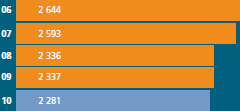
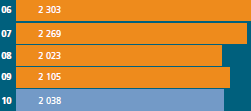
The primary resources used by Northam are water, energy and bulk materials such as rock (mined and processed) liquid fuels, coal, grease, steel, timber and lubricating and hydraulic oils. Zondereinde actively optimises its resource usage and recycling programmes are in place for plastics, steel, timber and scrap. Bulk material usage and recycling performance are presented in the tables and graphs below.
| Materials used | Unit | F2010 |
|---|---|---|
| Rock mined | 000t | 2 281 |
| Ore milled | 000t | 2 105 |
| Timber | m3 | 3 528 |
| Cartridge explosives | t | 2 650 |
| Oxygen | t | 3 131 |
| Sulphuric acid | t | 1 064 |
| Sulphur dioxide | t | 122 |
| Grease | t | 61 |
| Lubricating and hydraulics oils | l | 125 034 |
| Materials recycled | Unit | F2010 |
|---|---|---|
| Plastic | t | 14 |
| Steel | t | 1 508 |
| Timber | m3 | 6 402 |
| Scrap metal | m3 | 2 557 |
| Rubber | t | 168 |
| Lubricating and hydraulics oils | l | 125 034 |
Rock mined (000t)
Ore milled (000t)
Water
Water is of critical importance to operations at the Zondereinde mine as the mine largely operates on hydro-power. Water management and water quality are therefore an integral part of the management of Northam’s operations.
The total water usage at Zondereinde for F2010 was 27 426 000m3 (Water usage in F2009 was underreported as it excluded water used in Setaria village).
Two primary water sources contribute to the total water used at Zondereinde:
Industrial water is used for all mining and processing operations and constitutes around 90% of total water usage on an annual basis. This water is maintained within a closed circuit and recycled on an ongoing basis.
Given the geography and climate of the region, where surface temperatures may reach as high as 40°C in summer, evaporation rates are high. The water is exposed to evaporation while it is contained within the processing facilities, on the tailings dams and in storage facilities, and needs to be supplemented by about 10% on an annual basis.
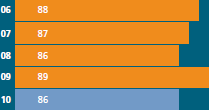
Water usage (000m3) F2010 F2009 Potable water from external sources 2 601 1 858 Fissure water used 1 385 1 445 Total water used 27 426 18 382 Water recycled in process 23 440 15 079 % water recycled 86% 89% * The F2009 potable water from external sources figure was under reported as water use in Setaria village was not accounted for.
* The F2009 water recycled in process figure was under reported as water recycled from bulk air conditioners was not accounted for.
During F2010, around 5% of total industrial water was sourced from fissure water which seeps into the deep level underground workings. During the 20 years since mining started at Zondereinde, there has not been a significant change in the rate of fissure water flow as a result of mining operations. The fissure water flow is not seasonal which is a clear indication that this water is distinct from rechargeable groundwater.
Zondereinde does not source water from riverine systems, surface sources or from perched aquifers (that is, groundwater). The balance of surface water make-up comes from rainfall onto the property which is captured in the dams, and which by definition then becomes grey water.
- Around 10% of the total daily water usage at Zondereinde is potable water purchased from the Magalies Water Board on an annual basis.
As the company’s operations are located in an area where water is considered a scarce resource, Northam recognises that water availability may in future be constrained as a result of increasing industrial pressure on water supply and as a result of climate change, and therefore needs to be conserved. While Zondereinde does not consume water from local sources or has an impact on them, it remains an active participant in matters relating to water management in the area by way of, amongst other approaches, discussing water issues with local community members and farmers whose properties surround the company’s operations. Zondereinde is a participant within the Crocodile River and Groot Marico Catchment Management Authorities.
When overflow is inevitable due to heavy and sudden rainfall, discharge conditions are monitored and discharge is carried out from the treated sewerage effluent dam and evaporation dam into the Bierspruit. This occurred on one occasion in April, 2010 as a result of heavy rainfall and was done in strict compliance with permit conditions.
Sampling of underground and surface water at Booysendal continued during the year. The data qualified during F2010 provides base line information on the actual water quality in the area before any mining-associated impacts occur.
Water recycled (%)
Energy
Given Northam’s existing relatively low base of energy consumption at its mining operations and the likelihood of increased energy consumption at Zondereinde as a result of extending the mine to greater depths to maintain production and the ramping up of production at Booysendal, Northam will not be able to reduce energy consumption going forward. However, the company is committed to optimising its usage to maintain or reduce usage per PGM ounce produced.
Energy consumption, in particular energy efficiency, are issues which receive significant attention at Zondereinde. Not only does the purchase of electricity amount to a considerable contributor to costs at R205 million (9.2% of on-mine costs in F2010), but electricity is also a scarce resource which needs to be conserved. Zondereinde in particular, is highly reliant on hydropower and Northam continues to investigate potential and cost-effective alternative sources of energy.
Furthermore, the National Energy Regulator of South Africa (Nersa) approved a power tariff increase of 24.8% which came into full effect on 1 April 2010. This has had a major impact on the overall operating costs of all producers, and this is likely to continue in future. Again, owing to the extensive use of hydropower at Zondereinde, Northam continues to be presented with an economic advantage due to the fact that the company uses less electricity than its peers. In addition, Northam’s experience of using an alternative source of energy has resulted in the establishment of a culture and infrastructure which forms a platform from which further renewable energy innovations may be developed in the short to medium term.
| Electricity consumption (MWh) | F2010 | F2009 |
|---|---|---|
| Energy from electricity purchased by shafts | 483 541 | 473 181 |
| Energy from electricity purchased by plant | 156 199 | 127 831 |
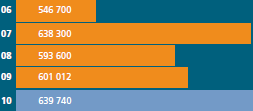
| Total electricity purchased | 639 740 | 601 012 |
Total energy consumption from electricity purchased increased by 6% to 639 740MWh in F2010 (F2009: 601 012MWh) with around 23% of electricity used by processing and smelting activities and 77% by mining operations. In an effort to reduce energy consumption, Northam has embarked on a renewable energy and energy conservation scheme together with Eskom. As part of this scheme, seven energy saving projects have been implemented and it is estimated that this has resulted in a 225 609MWh (26%) saving on the total energy consumption from electricity purchased during F2010.
These energy saving projects include:
- the roll-out of compact fluorescent lighting and geyser blankets to mining staff and Setaria village residents;
- the modification of electrical geysers to solar power;
- the use of hydro-powered equipment for drilling, cooling and cleaning operations;
- the use of backfill to support mined areas which also reduces heat ingress and has resulted in a 65% decrease in the size of the area which needs to be cooled;
- the use of Power Factor Correction equipment which reduces the electrical load and minimises wasted energy and thus improving efficiency while reducing the electricity bill; and
- the conversion of mast and street lighting to energy saving lights.
The outcome of the optimisation studies undertaken at Booysendal has meant a revised mine design and higher rate of production at full capacity, which will result in electricity consumption exceeding the Eskom approved 20MVA during peak demand periods. These requirements will be fulfiled by self-generation of power on site (5MVA) during peak times. This will continue until Eskom is able to supply additional power – currently estimated to be by 2015.
The revised design also makes provision for an energy management system and the introduction of energy recovery strategies. Orepass capacity is being improved which will minimise the requirement for decline conveyors to run during peak shift times. In addition, cycle efficiencies and optimised equipment selection will maximise output in each section, and at the same time reduce the number of sections required to operate, and so reduce energy requirements.
Total electricity purchased (MW/hour)
Emissions and discharges
The most significant emissions or potential discharges from Zondereinde are SO2 emissions (directly from the smelting operations), CO2 emissions (direct and indirect), potential discharges to water courses and dust generation from tailings dams.
SO2 emissions
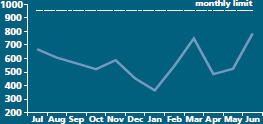
In total, 6 853 tonnes of SO2 was released into the atmosphere in F2010 from the Zondereinde smelting facility (F2009:3 650 tonnes). This translates into an average of 18.8 tonnes per day (F2009: 10.3 tonnes per day). Northam’s current permit allows for an average of 32 tonnes per day.
CO2 emissions
Northam is in the process of developing its climate change mitigation strategy and has implemented a variety of energy saving and efficiency projects to reduce electricity consumption and therefore the amount of greenhouse gases (GHGs) admitted into the atmosphere as a result of its activities. During F2010, Northam placed a great deal of emphasis on accurately calculating the carbon emissions of its Zondereinde operation with GHG information reported on a monthly basis, under the oversight of the engineering manager. A carbon footprint calculation tool has been developed for Northam and is used to determine the carbon footprint of Northam’s activities.
| Greenhouse gas emissions | |
|---|---|
| (Scope 1, Scope 2 and Scope 3) CO2e (tonnes) | F2010 |
| Total global Scope 1 emissions (direct emissions) | 16 796 |
| Total global Scope 2 emissions (indirect emissions) | 658 932 |
| Total global Scope 3 emissions (indirect emissions) | 1 388 |
| Total emissions | 677 116 |
For more detailed information on GHGs and Northam’s assessment of the risks and opportunities presented to the company as a result of climate change, view Northam’s submission to the Carbon Disclosure Project’s 2010 annual survey which may be found at www.cdproject.net and on Northam’s website.
Northam has considered the risks and opportunities relating to climate change and has detailed these in its CDP submission. Briefly, physical and regulatory risks have been identified and the company intends to manage them through its energy conservation initiatives (as the bulk of Zondereinde’s CO2 emissions are largely attributable to indirect emissions from electricity purchased from Eskom).
Climate change presents an opportunity for Northam too. PGMs are used in technologies that bring about reduction in noxious gases and the global trend of tightening emissions legislation continues to stimulate PGMs usage in autocatalysis. Further, platinum is used as the basis of fuel cells, which hold vast potential as an alternative energy source.
Water discharges
Zondereinde endeavours to run a zero discharge operation and closely monitors any potential impact of its operations on surface and groundwater sources. Extensive monitoring is undertaken and a comprehensive groundwater model, developed and maintained by a third party consultant, has been in place for five years. This consultant also monitors and advises on surface and groundwater quality control.
Similar controls are planned to be implemented at Booysendal. A number of boreholes were drilled across the property in 2008 to determine the baseline quantity and quality of water.
Dust management
During the year, Zondereinde engaged the services of an external service provider to develop a ground level air pollution concentration model. It is expected that this model will be completed during F2011.
At Booysendal, monthly dust deposition monitoring was conducted during the year to provide baseline information on the dust levels in the area before mining activities commence. Northam will continue to monitor dust deposition in the areas adjacent to the Booysendal project to determine the level of impact of mining activities on the area and to develop dust mitigation procedures to reduce its impact on the area.
Land management and biodiversity
Zondereinde’s landholding is far greater than the actual complex’s surface footprint, with the lease area covering some 5 183 hectares.
Of the land under management, only 576 hectares (11%), has been disturbed by mining, processing, deposition and related activities, including the mine village. The tailings dam and waste rock dump account for around 281 hectares – or 5% of the Zondereinde landholding. Land leased to farmers covers 273 hectares (5%) of the total area, while Northam maintains 800 hectares (15%) of the landholding for conservation and biodiversity purposes. The balance of the land (68%) remains in its natural state.
| Land use (hectares) | |
|---|---|
| Land disturbed by mining and related activities | 576 |
| Land leased for farming purposes | 273 |
| Land protected for conservation | 800 |
| Total land under management (freehold) | 5 183 |
None of the company’s activities are situated in areas protected by the World Conservation Union, heritage sites or biosphere reserves and no Red Data species have been identified on or adjacent to the mine property.
Northam conducted an extensive environmental study to improve the level of monitoring and maintenance of invasive plant species on the Zondereinde property. As part of this study, the lease area was re-assessed by way of aerial and terrain surveys. The data generated by the surveys was used to re-evaluate alien plant species and to update the current status of biodiversity in the area. Based on the re-evaluation, practical guidelines for the control and eradication of invasive alien vegetation were developed and included in an environmental control programme which also outlines the locality, population density and eradication methods of invasive plant species.
The TSFs will be rehabilitated as deposition concludes to reduce dust levels and for aesthetic reasons. However, final rehabilitation will only occur after closure.
The Booysendal project is situated in an ecologically unspoilt area – the Der Brochen valley – where Northam’s land stewardship covers an area of some 3 800 hectares.
Extensive work has been undertaken on the planning of the layout for Booysendal. The positioning of the concentrator plant has been optimised to take account of the higher run of mine (ROM) production, resulting in a more efficient process flow and a smaller environmental footprint.
During the year under review, an extensive investigation into the abundance of the endemic cicada, Pycna sylvia was completed. This investigation provided vital information about where to assemble infrastructure on the property so as to reduce the impact of mining activity on the natural habitat of the cicada. Three major areas which occur in close proximity to mining infrastructure were identified on the Booysendal property. These areas have been cordoned off and fenced to avoid further impacts on the natural habitat of the cicada.
Planning for closure
Zondereinde is currently revising its EMP and planning for closure will be taken into consideration in this submission.
At the end of June 2010, Northam’s total environmental liability was estimated at R65 million (F2009: R54 million). As prescribed by law, the company has a rehabilitation trust fund in place currently valued at R27 million.
Planning for closure was completed at Booysendal and a three-phased rehabilitation plan was submitted to the DMR during F2010. In addition, Northam has lodged a guarantee with the DMR to the value of R66 million to provide funding for the rehabilitation covering the first five years of the project.
Northam gives the cold shoulder to its unwelcome guests
During F2010, Northam continued to identify, monitor and eradicate invasive plant species found on the company’s Zondereinde lease area as part of the company’s overall environmental management plan for the area. The plan was developed following a detailed examination of intrusive plant species during F2009 based on a previous study completed in 2004. As part of the reassessment of the area, an aerial survey was carried out to identify exotic plant species and plot them on a map.
Invasive plant species were prioritised according to the various stages of invasion and the degree of ecological threat. The four major invasive plants on the property were identified as Arundu donax, Tamarix ramosissima, Texoma stans and Melia azedarac. Although some of these plants are not classified as transformers, they pose a definite threat to the indigenous vegetation and habitat in the area by significantly degrading the ecosystem.
Melia azedarac, or the syringa tree, is classified as a transformer plant and has the ability to alter the indigenous vegetation structure in the area. A dense stand of these trees occurs along the Crocodile River. Although the eradication of this species is a priority, some raptor and other bigger nesting sites have been identified in the area. Individual trees where these nesting sites occur were not removed immediately but continuous monitoring of the area is undertaken on a regular basis to determine when they are not used for breeding so they can be ringbarked or cut down.
“In view of the large number of indigenous plant and animal species located in the area, we had to consider the impact our programme would have on the entire ecosystem, not only plants. It is basically like getting rid of an unwelcome guest at a dinner party without disturbing the other guests,” says environmental officer, Orelia Bezuidenhout.
Based on the findings of the study, practical procedures for the eradication and control of invasive plants on the Zondereinde lease area, which covers 5 183 hectares, were developed based on guidelines set out by the Conservation of Agriculture Resources Act.
Basic control teams, consisting of ten people have been trained to apply initial control methods including hand cutting, ring-barking and manual application of plant-specific herbicides.
“Not only are we preserving the natural habitat in the area, but participants are also receiving valuable on-the-job training,” concludes Orelia.
Monthly SO2 emissions (tonnes)
NORTHAM SUSTAINABLE DEVELOPMENT REPORT 2010