

Governance
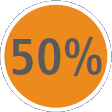
No fewer than 50% of the directors are required to be historically disadvantaged persons.
Northam is committed to upholding and implementing principles of good corporate governance at all levels of the company. The directors endorse the Code of Corporate Practices and Conduct set out in the King Report on Corporate Governance 2002 and 2010 (King II and King III). A detailed account of corporate governance matters may be found in the Annual Report.
Compliance
The key principles underlying the King II recommendations are reflected in the group’s corporate governance structures. Northam is substantially compliant with King II and differs only in those areas where the formation of the group as a leading BEE entity has required special variances. The primary area of noncompliance is that the chairman, as well as the majority of directors, are not deemed to be independent. It is envisaged that once the unbundling of the company from the major controlling shareholder, Mvela Resources, is completed, the situation will be resolved.
In F2010, the company commissioned an independent review of its compliance with King III. Specifically, this review examined current practices, and an analysis of the gaps that exist between current practice and King III. Remedial or other actions have been suggested and these are being considered by Northam, prior to implementation. Northam is committed to the implementation of King III within the next financial year.
Significant legal issues or fines
Northam did not incur any fines during the year under review in respect of non-compliance with law or regulations, and was not involved in any legal action relating to anti-competitive behaviour, anti-trust or monopoly practices. Similarly the company is not engaged in any significant legal actions.
Leadership and oversight by the board
Northam’s board has a unitary structure, and comprises 11 members (and two alternates). Board members assume overall responsibility for the company and its activities, including risk management and governance. The board is responsible to shareholders for setting the direction of the group through the establishment of strategic objectives and key policies.
The board is guided by the board charter, and is supported in its role by a number of board committees, namely:
- the audit committee
- the health, safety and environment committee; and
- the remuneration, nomination and employment equity committee.
The board comprises two executive and nine nonexecutive directors, four of whom are regarded as being independent since they are not representative of a share owner who has the ability to control or significantly influence management; have not been employed by the company, or the group of which it currently forms part in any executive capacity for the preceding three financial years; are not members of the immediate family of any individual who is, or has been in any of the past three financial years, employed by the company or group in an executive capacity; are not professional advisors to the company or the group, other than in a director capacity; are not a significant supplier to, or customer of the company or group; have no significant contractual relationship with the company or group, and are free from any business or other relationship that could be seen to materially interfere with their capacity to act in an independent manner.
In terms of the company’s articles of association no fewer than 50% of the directors are required to be historically disadvantaged persons (HDPs) as defined in the MPRDA. To this end, the board has appointed additional non-executive directors who qualify as HDPs, thus bringing the total number of such directors to six of the eleven directors.
The board charter regulates how business is to be conducted by the board in accordance with the principles of good corporate governance. The charter sets out the specific responsibilities of the board members collectively, and the individual roles expected of them. More specifically, the charter confirms the board’s responsibility for the adoption of strategic plans, monitoring of operational performance and management, determination of policies and processes to ensure the integrity of the group’s risk management and internal controls, as well as director selection, orientation and evaluation.
The board recognises that improved performance and effectiveness may be achieved through regular and timely appraisals both of the board as a collective and of its individual members. The board ensures that the remuneration of both board members and senior executives reflect the overall performance of the company as a whole, including financial and nonfinancial performance indicators. At an operational level, this includes performance relating to transformation, environmental management and safety and health. Safety performance forms a fundamental part of the calculation of remuneration for operational management and employees.
Sustainability leadership
Policies, practices and performance relating to sustainable development form an integral part of the management of the company. While overall responsibility for sustainability lies with the board, specific oversight has been delegated to the health, safety and environmental committee and the remuneration, nomination and employment equity committee.
These committees function in accordance with established terms of reference approved by the board and material matters (always including safety) are escalated to board level for consideration. Transformation and compliance with the MPRDA and the Mining Charter are considered by the board as a whole and are a standard agenda item.
The health, safety and environmental committee comprises four non-executive directors, under the chairmanship of Bernard van Rooyen, and met on four occasions in F2010. The remuneration, nomination and employee equity committee, under the chairmanship of Emily Kgosi, is also made up of four non-executive directors and met four times during the year.
Code of ethics
Northam is committed to the highest ethical standards. Northam’s code of ethics governs relationships between the group and its stakeholders. Contravention of the code may result in disciplinary action and, depending on the nature of the contravention, may also result in civil or criminal action. The code of ethics has been aligned with corporate governance trends and practices.
Political donations
It is a policy of the Northam board not to make political donations of any kind. No donations were made in F2010.
Risk management
Risk management is an integral part of the company’s strategic and business processes. Northam is confident that the precautionary approach – as envisaged in environmental legislation – has been adopted.
The board is responsible for the oversight of risk management within the group, with board committees and management being consecutively accountable to the board. Extensive systems of internal control are in place to identify and manage significant risks. These systems support the board in discharging its responsibility of ensuring that the range of risks associated with the group’s operations are managed effectively and that the interests of stakeholders are safeguarded.
Through an integrated risk management framework, significant risks facing the group, as well as factors in mitigation thereof, are identified and addressed. While the operating risks cannot be fully eliminated, the group endeavours to minimise them by ensuring that appropriate infrastructure, controls, systems and ethics are applied throughout the group to manage such risks.
The framework identifies all the activities carried out in the various processes, the assessment of the impact of the inherent risks within those activities, and/or processes and measures taken or to be taken to mitigate such risks. A risk matrix is subject to annual review by management in conjunction with the group’s internal auditors. The major risks are aligned with the material issues (PDF - 55KB) identified in the annual report.
Northam engages with underwriters and assurors on an ongoing basis and a significant portion of the company’s operational risk is underwritten.
Engagement with stakeholders
Northam has identified the following broad groups of stakeholders, namely shareholders, employees, unions, communities, government and regulators, non-governmental organisations (NGOs), suppliers, contractors, customers, and the public at large.
While there is no formal overall stakeholder engagement process in place, extensive and ongoing interaction with stakeholders is undertaken by the various disciplines, for example:
- investors, analysts and media, by the investor relations discipline;
- communities, government and NGOs, by the community relations teams;
- regulators, government, and local farmers, by the environmental discipline;
- customers and partners, by the marketing discipline;
- employees, unions and communities, by the human resources discipline; and
- the regulators, employees, unions and peer companies, by the safety and health discipline.
Any issues raised by these various stakeholders are dealt with directly and, where appropriate, escalated to the attention of the board. This indirect input was considered during the identification process of the company’s material issues outlined in the From the chairman and CEO. All discipline heads were involved in this process.
Northam ensures that the principles of openness, integrity and accountability are adopted, and will provide timeous, relevant and meaningful reporting to all stakeholders.
The depth and frequency of formal communications exceeds the statutory requirements and include press releases, briefings and a website. Briefings, newsletters, posters and other appropriate media are used to communicate specifically with employees. The group encourages proactive two-way engagement with stakeholders by way of hosting visits, open days, conducting surveys and through other communication channels.
Shareholders are encouraged to participate in the annual general meeting of the company and directly raise issues of concern or interest. Employees are encouraged to raise issues of concern and interest via the formal and informal structures in place, including through the human resources discipline, line management or union structures.
Commitment to external initiatives
Northam supports the International Platinum Association (ipa-news.com/en) and the Platinum Guild International (PGI) (www.platinumguild.com) which promote the use of platinum internationally.
Northam subscribes to the Global Reporting Initiative (GRI) and has adopted GRI’s guidelines as the basis of its reporting.
NORTHAM SUSTAINABLE DEVELOPMENT REPORT 2010